

Written by Prof. Jan Lundell, Director of LUMA Centre Finland
I recently had the pleasure and honour of being invited to visit the Royal Society of Edinburgh. A two-day visit was filled with interesting discussions on the national STEM strategy and the impact it is bound to have on future society and wellbeing. There are many similarities between the Scottish and Finnish approaches to STEM education. The biggest differences appear to be in Finland’s systemic development-for-better approach throughout the educational system and strategic thinking to support the development initiatives.
We tend to say in Finland that the future is a collective state of mind. We need to work together and especially concentrate on leaving no child behind in education. Equality and equity are important to offer all students equal possibilities in education. However, in recent times, students tend to see STEM as important but not worth pursuing as a career choice.
The Finnish way is to have a governmental STEM strategy that is nurtured by governmental programmes, a teacher education vision for 2050, and the Finnish Research, Development and Innovation Roadmap to 2030. It is all about systematic development of STEM and STEM literacy in the population, and connecting STEM to the actual, current events, phenomena, and challenges in society and everyday life. It took us too long to realise that we need to do this together, involving all stakeholders to influence the governance of school education and the attitudes of parents and society in general.
Two days in Edinburgh
On the first day of my visit, the RSE organised a public event to foster a broad discussion of the similarities and differences in science literacy, especially in science teacher education, between Finland and Scotland. Certain issues common to both countries appeared. The STEM skills of primary school teachers represent a core common focus of interest – especially since reading, writing, and mathematical skills are basic requirements for further education and, finally, valued career choices.
When talking about teachers – who are at the core of meaningful STEM education – there is a need to intertwine science and pedagogy skills in science education. This yields positive results for both teacher practice in schools and teacher training at universities. This approach is combined with and underpinned by evidence and inquiry-based teaching, curriculum development, and assessment practices. Why is it so difficult to trust teachers’ skills and to provide them with autonomous decision-making in the classroom?
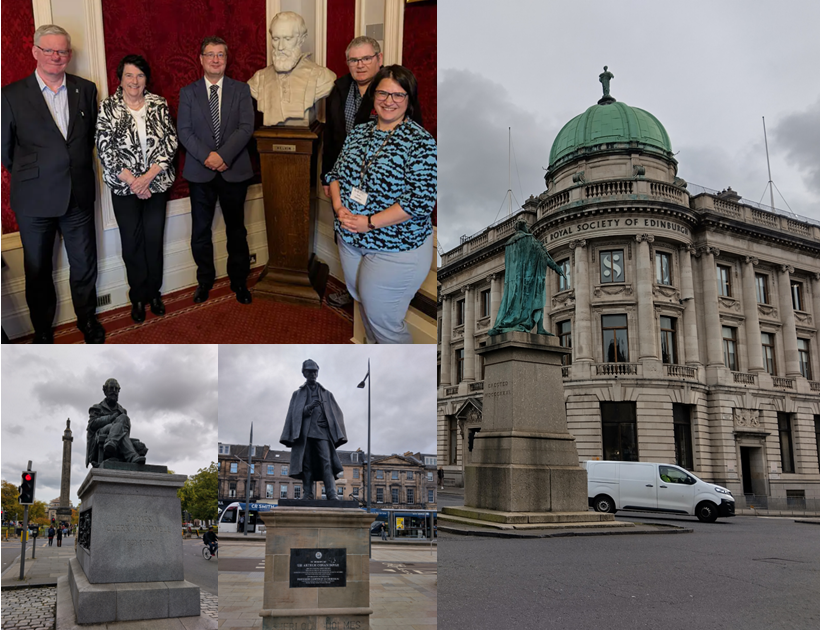
Lower left: Under the watchful eyes of James Clerk Maxwell and Sherlock Holmes.
On the right, the Statue of King Edward IV is guarding the RSE building.
On the second day, during a meeting with the Learned Societies’ Group on Scottish STEM Education (LSG) that discussed the policy aspects of the STEM strategy, the PISA results came up. The lack of interest in science – that has resulted from a steady decline in both the number of students for the sciences themselves and the number of science teachers – is a constantly increasing challenge. Also, identifying evidence-based improvements and evidence-based solutions to be fed back into the system came up in the discussions. How much evidence do we need before it is sufficient for initiating a change of practice and attitudes?
One idea that struck me at the LSG meeting followed a comment that was raised on a very interesting and important question related to the discussions conducted during my visit.
“If Finland thinks it is important for the country that there is a STEM strategy to tackle future needs of STEM skills and STEM-informed workers to answer the global challenges and technology-related changes in industry or society, why does Scotland not need one?”
My immediate thought was, How does Scotland answer this question? How could the RSE help the decision makers to formulate an evidence-based answer? The questions seem to trouble the LSG members, since there appear to be no straightforward answers to these questions. Something needs to be done, but where to begin and how to bring the stakeholders on board for this?
The LUMA motto is “Together we are more!” I am sure that Scotland can find a common page to turn the dislike and negligence of STEM as education for the future, career choices, or innovations. STEM is the future of society, well-being, and the best approach to answer the global challenges trying to tackle us all the time.
I wish for policymakers, educators, parents, and children and youth to see STEM as a superpower that helps to solve problems and change society for the better. We are still working on that in Finland.
Nevertheless, some issues are clear. Teachers are needed, and they can change the world. STEM literacy is essential in the rapidly changing society we now inhabit. With STEM, one can answer the multiple global, multidisciplinary challenges we are facing on Earth.
We need sustainable, inclusive, meaningful, and relevant STEM education and lifelong learning. As one B.Sc. student put it in a recent Finnish evaluation of high school STEM programs: “[I] Just love the subject!” That love changes society and saves the world.
Whole blog and its commentaries are published on the RSE website: https://rse.org.uk/resource/il-luma-nating-stem-education/