MoocWise Project Advances AI‑Supported STEM and Well‑being Education Through Finnish–Chinese Collaboration

MoocWise Project Banner. Made by AI.

The MoocWise project is a joint initiative between Finnish and Chinese higher education institutions, bringing together educators and PhD students to co-create a Massive Open Online Course (MOOC) on AI in STEM Education and Well-being. The project exemplifies the goals of the Team Finland Knowledge programme by fostering cross-cultural and interdisciplinary cooperation across continents. It is funded by the Finnish National Agency for Education and forms part of LUMA Centre Finland’s operations.

Building a joint MOOC on shared expertise

Designed as a blended international collaboration, the MOOC development will combine ongoing online work with intensive onsite meetings held in both Finland and China. The Finnish partners include the University of Helsinki (UH) and the University of Turku (UTU), while the Chinese partners are Beijing Normal University (BNU) and Shanghai Jiao Tong University (SJTU). This mirrored structure ensures balanced exchange and shared ownership from the outset.

The MOOC will introduce cutting-edge AI tools for use in STEM and well-being education, with a strong emphasis on cultivating a critical and ethical understanding of their pedagogical potential and limitations. The aim is to support educators in integrating AI into teaching with confidence and creativity – enhancing student agency, critical thinking, equity, and well-being.

Co-creation and research-based design at the heart of the project

A distinctive feature of the project is its co-creation model. PhD students and teacher educators from both countries will develop course materials together, testing and iterating them during onsite sessions. This participatory approach ensures that the MOOC reflects diverse cultural and disciplinary perspectives and is grounded in research-based pedagogies. Course participants will be encouraged to explore AI tools hands-on, while interactive peer activities will support shared reflection and collaborative learning.

The first onsite collaboration will take place in Helsinki and Turku in August 2026, followed by a second intensive working period in Beijing and Shanghai in October 2026. These meetings will enable deep academic exchange, cultural learning, and real-time refinement of course materials with the support of participating students and educators.

Creating sustainable partnerships and future-ready education

By combining Finnish expertise in student‑centered STEM education with Chinese strengths in well‑being‑oriented AI applications, the project builds a powerful synergy. It strengthens sustainable academic partnerships, enhances digital readiness, and expands international learning opportunities. The initiative aligns closely with the goals of the Sino‑Finnish JoLII network, contributing a forward-looking model for global collaboration in higher education.

The MoocWise project is led by Professor László Major from LUMA Centre South-West (read more on the Centre’s website). Collaboration includes LUMAlab Gadolin at the University of Helsinki, coordinated by Professor Maija Aksela (read more on LUMA news), together with deputy coordinator Maikki Roiha, who also serves as MoocWise project coordinator. Professor Jun Wang (BNU), Associate Professor Pengfei Xu (BNU), and Associate Professor Xin Tang (SJTU, UH) play key roles in shaping the course content and supporting research based design. The project team also includes Postdoctoral Researcher Jenny Niu (UH) and JoLII representative Sammy Yang Jing (BNU) whose contributions in pedagogy, curriculum design, and co-creation further strengthen the collaborative effort.

Finland has established a national STEM strategy (Ministry of Education and Culture, 2023), aiming to ensure a sufficient level of science competence and societal understanding to support well-being and sustainable growth. The MoocWise project contributes to these national objectives. The strategy is available on the Ministry’s website.

Il-LUMA-nating STEM education

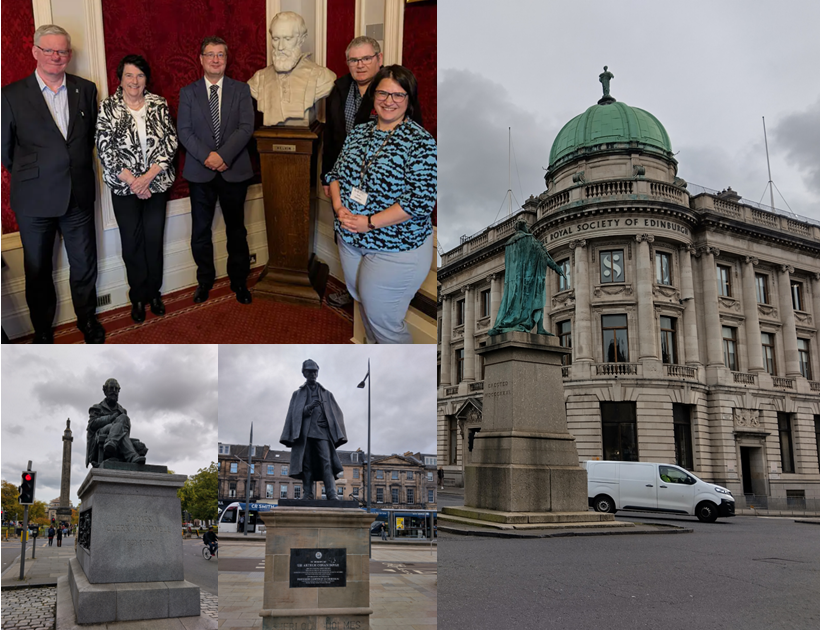
Connor Mollisonin ottama valokuva Edinburghista.

Written by Prof. Jan Lundell, Director of LUMA Centre Finland

I recently had the pleasure and honour of being invited to visit the Royal Society of Edinburgh. A two-day visit was filled with interesting discussions on the national STEM strategy and the impact it is bound to have on future society and wellbeing. There are many similarities between the Scottish and Finnish approaches to STEM education. The biggest differences appear to be in Finland’s systemic development-for-better approach throughout the educational system and strategic thinking to support the development initiatives.

We tend to say in Finland that the future is a collective state of mind. We need to work together and especially concentrate on leaving no child behind in education. Equality and equity are important to offer all students equal possibilities in education. However, in recent times, students tend to see STEM as important but not worth pursuing as a career choice.

The Finnish way is to have a governmental STEM strategy that is nurtured by governmental programmes, a teacher education vision for 2050, and the Finnish Research, Development and Innovation Roadmap to 2030. It is all about systematic development of STEM and STEM literacy in the population, and connecting STEM to the actual, current events, phenomena, and challenges in society and everyday life. It took us too long to realise that we need to do this together, involving all stakeholders to influence the governance of school education and the attitudes of parents and society in general.

Two days in Edinburgh

On the first day of my visit, the RSE organised a public event to foster a broad discussion of the similarities and differences in science literacy, especially in science teacher education, between Finland and Scotland. Certain issues common to both countries appeared. The STEM skills of primary school teachers represent a core common focus of interest – especially since reading, writing, and mathematical skills are basic requirements for further education and, finally, valued career choices.

When talking about teachers – who are at the core of meaningful STEM education – there is a need to intertwine science and pedagogy skills in science education. This yields positive results for both teacher practice in schools and teacher training at universities. This approach is combined with and underpinned by evidence and inquiry-based teaching, curriculum development, and assessment practices. Why is it so difficult to trust teachers’ skills and to provide them with autonomous decision-making in the classroom?

Upper left: Prof. Martin Hendry, Dr Susan Burr, Professor Jan Lundell, Stuart Farmer, and Dr Cristina Clopot under the solid gaze of Lord Kelvin.
Lower left: Under the watchful eyes of James Clerk Maxwell and Sherlock Holmes.
On the right, the Statue of King Edward IV is guarding the R
SE building.

On the second day, during a meeting with the Learned Societies’ Group on Scottish STEM Education (LSG) that discussed the policy aspects of the STEM strategy, the PISA results came up. The lack of interest in science – that has resulted from a steady decline in both the number of students for the sciences themselves and the number of science teachers – is a constantly increasing challenge. Also, identifying evidence-based improvements and evidence-based solutions to be fed back into the system came up in the discussions. How much evidence do we need before it is sufficient for initiating a change of practice and attitudes?

One idea that struck me at the LSG meeting followed a comment that was raised on a very interesting and important question related to the discussions conducted during my visit.

“If Finland thinks it is important for the country that there is a STEM strategy to tackle future needs of STEM skills and STEM-informed workers to answer the global challenges and technology-related changes in industry or society, why does Scotland not need one?”

My immediate thought was, How does Scotland answer this question? How could the RSE help the decision makers to formulate an evidence-based answer? The questions seem to trouble the LSG members, since there appear to be no straightforward answers to these questions. Something needs to be done, but where to begin and how to bring the stakeholders on board for this?

The LUMA motto is “Together we are more!” I am sure that Scotland can find a common page to turn the dislike and negligence of STEM as education for the future, career choices, or innovations. STEM is the future of society, well-being, and the best approach to answer the global challenges trying to tackle us all the time.

I wish for policymakers, educators, parents, and children and youth to see STEM as a superpower that helps to solve problems and change society for the better. We are still working on that in Finland.

Nevertheless, some issues are clear. Teachers are needed, and they can change the world. STEM literacy is essential in the rapidly changing society we now inhabit. With STEM, one can answer the multiple global, multidisciplinary challenges we are facing on Earth.

We need sustainable, inclusive, meaningful, and relevant STEM education and lifelong learning. As one B.Sc. student put it in a recent Finnish evaluation of high school STEM programs: “[I] Just love the subject!” That love changes society and saves the world.

Whole blog and its commentaries are published on the RSE website:  https://rse.org.uk/resource/il-luma-nating-stem-education/

Evästeasetukset
LUMA-kukka ilman tekstiä

This website uses cookies so that we can provide you with the best user experience possible. Cookie information is stored in your browser and performs functions such as recognizing you when you return to our website and helping our team to understand which sections of the website you find most interesting and useful.

You can adjust all of your cookie settings in this view.

Strictly Necessary Cookies

Strictly Necessary Cookie should be enabled at all times so that we can save your preferences for cookie settings.

Analytics

This website uses Google Analytics to collect anonymous information such as the number of visitors to the site, and the most popular pages.

Keeping this cookie enabled helps us to improve our website.