The Successful ChemistryLab Gadolin is a Unique Learning Environment at the University of Helsinki

Kuva tiedetapahtumasta, jonne on osallistunut perheitä.

ChemistryLab Gadolin at the University of Helsinki’s Department of Chemistry is an authentic, fully-equipped laboratory entirely dedicated to pre-school and school groups and developing chemistry education. In the Gadolin concept schools, academia and the business sector work together to build positive attitudes towards chemistry.

Imagine a science field trip to a state-of-the art laboratory in an authentic environment including cool hands-on experiments, interaction with real-life researchers and guaranteed student engagement in chemistry. Imagine that this field trip is free of charge, with all instructions and protocols freely available online for future classroom use.

Just a dream, you say? The dream is reality at ChemistryLab Gadolin, a laboratory that exists for the purpose of engaging 5 to 20 year-old students in meaningful chemistry learning.

Since its opening five years ago the Gadolin lab has hosted children, young people, teachers and other visitors from Finland and abroad. Up to date about 20 000 visitors have experienced the joy of chemistry at Gadolin. For example chemistry-themed birthday parties have emerged as a less-conventional but popular activity for children.

Promoting interest and skills in chemistry

Hosted by the Department of Chemistry, The Gadolin lab has close collaboration with the Unit of Chemistry Teacher Education and an excellent location at the heart of the Kumpula Science Campus at the University of Helsinki.

The aim of the Gadolin lab is to create and support students’ interest in chemistry. Gadolin activities seek to highlight five important themes in modern chemistry: everyday chemistry, green chemistry, material chemistry, energy, and health and wellbeing. Professor Markku Räsänen, the head of the Department of Chemistry, thinks that the Gadolin concept is “almost perfect,” and says that “the most important message of Gadolin is that without chemistry the most important challenges of mankind such as energy, health and the environment cannot be solved.”

Visits usually last from two to eight hours but longer courses can be arranged. Teachers can check the online reservation calendar and book a suitable time for their group by telephone.

Each group of students is different and can be involved in studying a particular topic of the curriculum. Because each group needs a personal approach, teachers are given the opportunity to tailor the content of their Gadolin visit together with experienced scientists and Gadolin instructors to suit the needs of that particular group of students. They can also design the content of the visit to suit any part of the national chemistry curriculum.

According to Räsänen Gadolin makes an impact. “Gadolin has increased positive visibility of chemistry in the society. This has led to great increase in the number of students applying to study chemistry. Over the years we have got students with much better starting skills,” he says.

From hands-on experiments to computer modeling

The name of the lab honors Johan Gadolin, who established the foundations of chemistry research in Finland and discovered the rare earth element Yttrium.

Gadolin offers a wealth of materials and a choice of over 50 experimental protocols and demonstrations. Visiting groups might choose to do practical experiments on a topic they are covering in class, tour the campus and meet experts who can share their knowledge or work with computers on molecular modeling or simulations.

Gadolin is well stocked with modern laboratory equipment such as an FT-IR, gas chromatograph, spectrophotometer and other technology so the students are introduced to the possibilities of automated measurement techniques commonly in use today.

Students might be especially interested in finding out what a researcher’s life is like in real life. In that case Gadolin can arrange visits to research laboratories in the Department of Chemistry, for example the laboratories of RadiochemistryPolymer ChemistryAnalytical Chemistry and so on, to meet the scientists in their working environments and to learn about the techniques and equipment they use.

Teaching approaches at the Gadolin lab are based on current research in STEM education. While translation is in-progress, materials are still mostly in Finnish or Swedish. Gadolin instructors can, however, guide the visitors in Finnish, Swedish or English.

Gadolin is all about collaboration

Collaboration between different sectors of the society is what ChemistryLab Gadolin is about. Not only does the collaboration of schools, the research community and the industry make Gadolin possible but they have also made it a great success.

Activities and education at the ChemistryLab Gadolin are developed together with schools and teachers as well as Gadolin staff and the steering group. “As one achievement Gadolin has helped school teachers in their everyday work. Enthusiasm is important for the teachers,” says professor Räsänen who participates in the Gadolin steering group. “Also, the leading branch of industry in our country gets visibility in the society. This also helps employment of the graduate students,” he adds.

The chemical industries take an interest in Gadolin and actively participate in developing the concept. The Finnish Chemical Industry Federation is an important supporter. “We sponsor ChemistryLab Gadolin because the concept is important for the entire area of chemical industry,” says Timo Leppä, Director General of the Chemical Industry Federation. “In addition to direct funding the Federation can act as a bridge between industrial enterprises, academic institutions and schools by providing knowledge and expertise as well as contacts and networks,” Leppä describes their role.

Also many companies have realized the importance and potential of the Gadolin lab for the future of Finnish expertise and show their support by direct funding or by sponsoring instruments, chemicals or other materials.

  • Funding: Kemira, Neste Oil, UPMAGABASF, Borealis Polymers, Bruker Corporation, The Chemical Industry Federation of Finland, Department of Chemistry
  • Instrument support: Epicur Group, IS-Vet, Laskentaväline, Metrohm Nordic, Miliot Science, PLD Finland, Suomen 3M, Thermo Fisher Scientific, VWR International

In addition to the sponsors, further collaboration involves a variety of partners such as the City of Helsinki, several departments of the University of Helsinki and many societies in the fields of e.g. chemistry, education and the industry.

Both Leppä and Räsänen consider Gadolin a success. Räsänen thinks that the Gadolin concept is “almost perfect”, but that it would benefit from wider international visibility.

“An essential accomplishment has been that the concept is up and running on a solid foundation so that we can concentrate on the goal of providing practical possibilities and opportunities for students to get excited about chemistry,”says Leppä who would like to strengthen the collaboration between the industry, academia and schools even further.

“I think it is important that the laboratory has been set up at the university campus where the scientific community, including education researchers, can directly support the development of the Gadolin concept,” Leppä continues. “But of course the most convincing sign of success is the huge amount of students and teachers visiting Gadolin every year.”

If you are interested in visiting the Gadolin lab, please contact director, professor Maija Aksela (maija.aksela@helsinki.fi).

Read more:

Text: Maija Pollari. Photo: Veikko Somerpuro.
Science Clubs Engage 3 to 6 year-olds in STEM

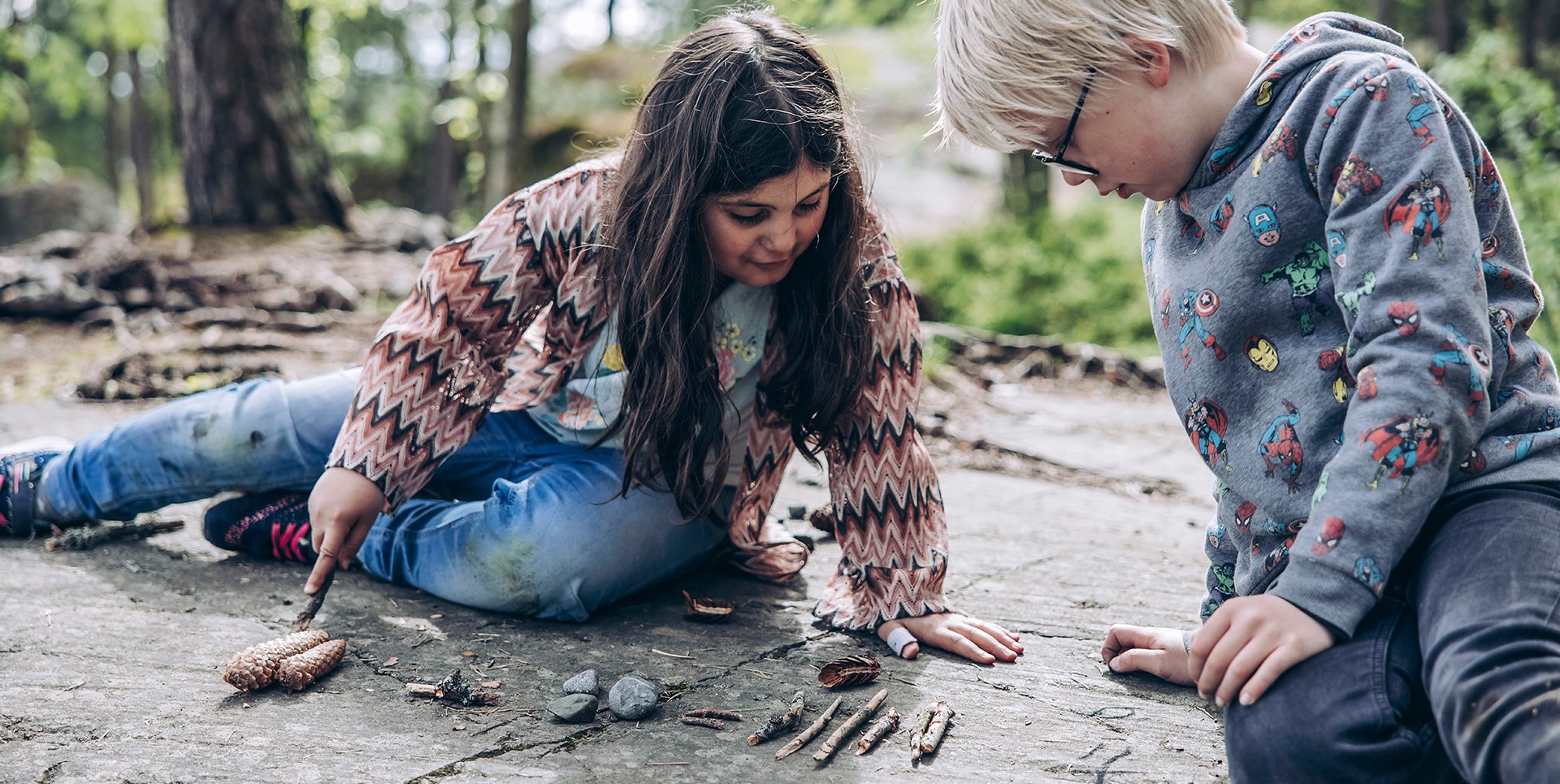
Kuvassa työttä ja poika ratkovat matemaattista tehtävää kävyillä ja kivillä kalliolla istuen.

In spring 2013 the LUMA Centre launched a novel science club model for 3 to 6-year old children. Project coordinator Jenni Vartiainen gives her insights on the design-based research project.

Curiosity towards our surroundings is something we recognize as a deeply human characteristic.

This ability to wonder is linked to our ability and willingness to learn new things. Small children especially display candid interest in everyday phenomena. For adults these phenomena have long since lost their novelty, but upon reflection they may reveal fundamental matters about the world and nature. By encouraging children’s curiosity educators can support and nourish their awareness of natural phenomena and even spark further interest in science.

First steps into STEM

Researchers at Finland’s Science Education Centre LUMA have explored ways of supporting the curiosity and interest of young children. Project coordinator Jenni Vartiainen used design-based research to develop a science club model for 3 to 6 year-olds.

The club model draws on the principles of socio-emotional learning to construct informal and inspiring STEM learning environments for young children. “Design research is an excellent way to develop a completely new approach. It is a great tool for analyzing the achievement of set goals and for redefining aims and research questions in further development cycles,” Vartiainen describes her method.

How to engage young children and their families in science?

The first clubs were organized as a pilot project in spring 2013 in Helsinki for 25 children in total. The club meetings were held for two age groups, 3 to 4 year-olds and 5 to 6 year-olds.

A similar structure was used for the club meetings in both age groups consisting of three stages: motivation, inquiry and sum up. In each meeting a different theme was explored, for example colors, density, space and dimensions and states of matter. In addition to the scientific themes and activities the club sessions were built on the development of social and emotional skills and motivation through art, narratives, music, drama and play. Repeated elements such as familiar songs were employed to emphasize a sense of security and familiarity in the children.

According to Vartiainen successful engagement in STEM begins with promoting a child’s natural ability to wonder and explore their surroundings.

“In my opinion it is crucial to familiarize children with the role of natural sciences and mathematics in their daily lives and to help them connect everyday phenomena to science and technology,” she says and continues to explain how “Long-term engagement cannot be sparked with cheap tricks. Children should be given a chance to wonder and ponder on something that interests them and, with the guidance of an adult, to realize their own solution. Interest and motivation in children is often awakened by exploring together the diverse ways in which natural sciences, technology and mathematics affect our lives.”

The club model encourages parental involvement and the participation of families. Vartiainen gives an example of how families participate: “After each club session the children are given an activity or excercise to be completed at home together with the rest of the family. The homework includes for example mathematics puzzles and simple practical experiments with household equipment. Parent can help the children record their answers, solutions and questions, which are discussed together at the next club meeting.”

According to feedback from the participants in the pilot clubs the model had successfully achieved its goals of increasing enthusiasm and curiosity towards natural sciences and supporting the development of personal thinking skills as well as social skills.

“The science clubs have been very important for the children: every club meeting is eagerly awaited and the children want to continue with the experiments at home. The dramatization of guide roles and the narrative framework have been successful in helping the children immerse themselves in inquiries and experiments,” says Vartiainen.

Vartiainen’s current research focuses on analyzing the questions children asked during club discussions and in developing new concepts based on the pilot club model.

“Our next plan is to launch virtual science clubs to increase the number of children involved in this kind of informal STEM education. Virtual clubs have the advantage of wider availability as participation becomes possible for children living further away,” Vartiainen reveals about future plans.

Next steps: virtual clubs to offer possibilities for all

Vartiainen sums up that there is a growing need for science clubs for young children. “Currently we need to solve the challenge of spreading and sharing the club model. The number of willing participants far exceeds our capacity and sadly we are not able to offer a club spot for all. This is an indication that despite the demand there are limited opportunities for science hobbies at a young age,” she says.

For Vartiainen, the best feedback comes directly from the responses of the young club participants: “Every time it moves me to see how fascinated the children are when they understand what they are doing and find a solution to the task at hand. The best reward is to witness how young eyes are lit by the excitement of discovery: “I understood, I figured this out, I could do this!”

Read more from Vartiainen, J., & Aksela, M. (2013). Science clubs for 3 to 6-year-olds: Science with joy of learning and achievement. LUMAT, 1(3), 315–321.

Text: Maija Pollari. Photo: Elisa Lautala.

STEM inspiration from the International Millennium Youth Camp 2014

The International Millennium Youth Camp brings together talented young people from all over the world to brainstorm and research science and technology-based solutions to mankind’s grand challenges. Application to the next Millennium Youth Camp is now open!

Energy, food and water are among today’s most important challenges with links to all aspects of the environment and society. New generations of skilled experts hold the keys to success in discovering solutions to these challenges. This is why enthusiastic young scientists are in urgent demand, and there is a growing need to create and support student interest and engagement in STEM subjects.

Since 2010 the International Millennium Youth Camp has attracted gifted young people who have a passion for science and technology. Organized by Finland’s Science Education Centre LUMA, Technology Academy Finland and Aalto University, the camp is a unique opportunity for bright young people to engage in science activities and to network with top level researchers and professionals. The goal of the camp is to promote interest in science and technology and to introduce STEM study and career opportunities in Finland.

The one-week-long camp takes place in the Helsinki metropolitan area and is free of charge to all participants including travel and accommodation. Participants of the camp are also accepted to study at the University of Helsinki’s Faculty of Science.

Inspiring science unites youth, academia and economic life

Professor Maija Aksela from the University of Helsinki has headed the Millennium Youth Camp since the beginning. “This is my fifth year as the head of the camp and I am still excitedly waiting for it! The camp is definitely the best work week of the summer for me,” she says, already looking forward to next years’ camp.

Aksela has seen the camp develop through the years. “The agenda has remained quite similar because it has been successful. Of course we have tailored the program according to feedback to better meet the needs of the campers,” she says.

Due to success and popularity, the camp has doubled in size to reach as many youth as possible. “The first three years we admitted 30 campers but now we have the opportunity to work with 60 gifted youngsters! In the 2013 camp we had campers attending from 30 different countries,” Aksela says.

The scope of the camp has also expanded to include a wider variety of themes. According to Aksela the different themes can be brought together under a common goal: “In the future we aim to focus more and more on the unifying theme of sustainable development.”

“This year Finnish companies and industrial partners have taken on an even more active role in the design of project tasks together with researchers from the academia. We have attracted new collaborators. For example Rovio, famous for the popular Angry Birds game, will share their ICT expertise with next years’ campers,” Aksela reveals about new openings for the 2014 camp.

Professor Aksela’s team has also published research on the Millennium Youth Camp. “Our research shows that the MYC experience has strengthened the career plans of the campers and their desire to study STEM subjects in the future. The scientists and experts they meet and interact with become important role models for the campers,” Aksela describes their conclusions.

Many of the campers feel that the Millennium Youth Camp was a life-changing and rewarding experience.

“For me, the best thing about MYC is that the camp has exposed me to my chosen subject and enabled me to find my interest in it. Urban planning will be one of my future career choices and the camp has no doubt given me a clearer direction for future,” says 2013 camp alumni Tang Yerong from China.

Camp highlights

The campers address global challenges through research in ten different theme groups: Applied Mathematics, Biosciences and Biotechnology, Climate and Climate change, Energy, ICT and Digitalization, Food Sciences and Food Technology, Material Sciences and Material Technology, Renewable Natural Resources, Urban Planning and Water.

Project work during the camp is carried out in small multinational groups which are mentored by experts from the field of study. Efforts culminate at the Millennium Youth Camp Gala event where the projects are presented to scientists, professionals of the industry as well as ambassadors and diplomats from various countries.

“This camp opened up my mind. There is so much more progress yet to come, and anyone can contribute to it,” says Romanian Andreea Cucu who was excited about the hands-on robotics approach chosen by the ICT team in 2013.

In addition to scientific content, informal social interaction and friendship form the heart of the camp. Camp alumni keep active contact to preserve friendships. “What I find most memorable about the camp is definitely meeting new people, who are very friendly and extremely multitalented, and with whom I still keep in touch on a daily basis,” says Stefan Velja from Serbia.

Abhi Parikh from Singapore echoes Velja: “[The camp] taught me new things, exposed me to new experiences but most importantly, it gave me friendships that I will always treasure.”

How to apply for the International Millennium Youth Camp 2014?

Attention everyone born in 1995-1998 and their teachers and educators: online application to the Millennium Youth Camp 2014 is now open!

Applicants can choose which theme group they wish to apply to according to their own interests and personal preferences. Applications must be sent in by December 15th 2013.

“Every person is gifted in one way or another and I would definitely recommend applying to the camp if one is even a little interested in meeting curious, active and enthusiastic people who care about science and technology!” is Aksela’s advice for potential applicants.

Text: Maija Pollari.

LUMA Celebrated European Biotech Week 2013

The European Biotech Week of 2013 was highlighted at Finland’s Science Education Centre LUMA with a variety of activities including workshops, themed articles and an on-line competition.

LUMA offered plenty of activities during the Eruopean Biotech Week from September 30th to October 4th 2013.

Interactive workshops were organized every evening at Chemistry Lab Gadolin and the LUMARTS laboratory at LUMA Centre Aalto to introduce teachers to practical and engaging biotechnology experiments. Workshop topics included building a functional electrophoresis machinery from simple kitchenware, biochemical separation and filtering techniques for milk and microbiology approaches to enzyme production.

An on-line competition was launched with a multiple-choice question on biotechnology appearing daily. Questions were designed to engage young people into thinking about everyday applications of biotechnology.

In addition, biotechnology-themed articles were published in the Finnish-language LUMA-sanomat webmagazine to support teachers with up-to-date information and to provide source material for classroom use. Featured articles emphasized Finnish biotechnology know-how and innovations ranging from the dairy industry to cutting edge research on personalized cancer treatments based on gene sequencing and high-throughput screening of potential drug compounds.

Text: Maija Pollari.

Nordic Research Symposium on Science Education (NFSUN2014) coming to Helsinki in June 2014

Coming up next summer: University of Helsinki will host the 11th Nordic Research Symposium on Science Education (NFSUN 2014) on June 4th – 6th 2014

Held every three years in one of the five Nordic countries (Finland, Sweden, Norway, Denmark and Iceland), NFSUN is an important forum for discussing and sharing ideas about science education. The conference brings together teachers and researchers to network and interact, report results and exchange ideas on current education research.

The 11th NFSUN conference is organized by the University of Helsinki and it will take place on June 4th – 6th 2014 at the Kumpula Science Campus in Helsinki.

Prominent international researchers have been engaged as keynote speakers. Doris Jorde, professor of Science Education from the University of Oslo, Lecturer Majken Korsager also from the University of Oslo and professor Alex Strømme from the Norwegian University of Science and Technology will give insights into the session entitled “Opening the science classroom to the opportunities for learning with technology”.

Judith S. Lederman (Director of Teacher Education) and professor Norman G. Lederman both from the Illinois Institute of Technology will also give keynote lectures. Kirsti Lonka, professor of Educational Psychology at the University of Helsinki will introduce the role of technologies in innovative pedagogy and in engaging the learner.

Call for papers

Present you results and gain visibility for your research at NFSUN 2014! Call for papers for NFSUN 2014 is now open. Research work and contributions can be submitted through an on-line form in three categories: i) a paper presentation ii) a poster presentation or iii) a symposium. A symposium-type of contribution can be used by a group of colleagues to present 3-4 projects united by a common theme.

Contributions from participants should fall into one of the five the science categories (biology, chemistry, physics, Earth science, science) and under one of the 16 strands of NFSUN 2014.

The deadline for submissions is January 31st 2014.

For more information please visit the NFSUN 2014 conference homepage.

Teaching Physics Students to Feel the Force

Recent doctoral dissertations from the universities of Helsinki and Jyväskylä update knowledge on the teaching and learning of essential concepts in physics.

Students encounter the concept of force not only in the Star Wars movies, but also in the physics classroom while studying Newton’s laws of mechanics.

In physics and other exact natural sciences the understanding and management of key concepts has an important role in the learning of central themes and issues. If abstract concepts are not actively processed and connected to reality, students may find them difficult to understand and as a results experience lack of motivation.

In order to develop conceptual understanding of a subject matter, students require familiarity with the associated language and representations such as symbols, graphs, diagrams and formulae. Additionally, the skills of physics teachers can be augmented through in-service trainings where they are familiarized with novel approaches and teaching methods.

Johanna Jauhiainen and Pasi Nieminen defended their doctoral theses in May 2013 in the University of Helsinki and Jyväskylä, respectively. Their studies provide new information on the usefulness of experimentation and representations in physics teaching. Both Jauhiainen and Nieminen approached their research themes through the learning and teaching of the concepts of force in Newtonian mechanics.

Both dissertations are available via the universities’ electronic archives:

Text: Maija Pollari.

Global Environmental Challenges in Science Education

The third International Symposium on Science Education (ISSE2013) gathered STEM teachers to Helsinki Finland in June 2013 to discuss and learn about global environmental challenges in science education.

Finland’s Science Education Centre LUMA organized the third International Symposium on Science Education (ISSE 2013) on 10th – 12th of June 2013. The conference was held at the Kumpula science campus of the University of Helsinki. The Kumpula campus is a hotspot of expertise in natural sciences and mathematics as well as teacher education in these areas, which makes it the ideal venue for the ISSE symposium.

The theme of ISSE 2013 was global environmental challenges in science education. Plenary talks by internationally recognized experts tackled important issues linked to the main theme. Professor Mauri Åhlberg, for example addressed developments in sustainability education while Markku Kulmala, professor of atmospheric sciences, discussed the underlying reasons and mechanisms of climate change.

Global water resources and making our limited supply of clean water last for future generations are some of the most important current challenges. The plenary lecture by professor of geosciences, Markku Löytönen, gave insights on the mismatching global supply and demand for clean water. Löytönen emphasized how important it is to realize how little water is available for use and consumption in some areas of the World.

The International Symposium on Science Education is an event for teachers, science experts and education researchers to meet, network and share ideas with international colleagues. In addition to invited plenary lectures the program included hands-on workshops and experimentation, poster sessions and discussions.

  • Check out the presentation slides and find out more from the ISSE 2013 program and abstracts for posters and workshops

The next International Symposium on Science Education (ISSE 2014) will also be held in Helsinki. Thematically the conference will focus on inquiry-based learning in science education through ICT experiments. More information will be available on the ISSE 2014 conference website.

Text: Maija Pollari

Information and Inspiration on e-Learning from Finland

A delegation of Saudi Arabian education experts visited LUMA Centre on Thursday 5th of September to find out about Finnish e-learning solutions.

The delegation of Saudi Arabian education specialists, including deans and vice-deans representing Saudi universities and faculties among others, were visiting the University of Helsinki on a three-day training program focused on e-learning, distance learning and blended learning. The goal of the visit was to enhance the participants’ competence in the use and development of e-learning applications and methods in their own work fields.

At the campus the delegates were welcomed by vice dean Juha Karhu, who briefly introduced the Faculty of Science and the topics of the day: learning case studies in Finnish science and medical education.

LUMA was profiled as a science education model bringing new ways of learning to students and teachers by linking universities, schools and the business sector in a meaningful symbiosis. “Ten years ago we started with an eagerness to share our love for science education but now we have acquired good experience, practices and successful models of learning to share,” said professor Juha Oikkonen, vice director of the LUMA Centre of the University of Helsinki. “Some of the new practices and approaches we have developed at the university level can be applied to other levels of education as well,” he continued.

Distance learning possibilities are especially important for teachers and students in remoter areas. One of the tangible examples of e-learning was an in-service training course for teachers: “Electronic learning environments in STEM education”. The virtual course is organized by the LUMA Centre and includes lectures, group activities, practical exercises and discussions, everything online.

During the day the delegates were also familiarized with e-learning solutions and the organization of different learning environments at the department of Computer Science and the Medical Faculty.

“We have much to share but also want to develop our work. We are always open to new ideas,” Oikkonen reminded his audience.

Text: Maija Pollari.

Evästeasetukset
LUMA-kukka ilman tekstiä

This website uses cookies so that we can provide you with the best user experience possible. Cookie information is stored in your browser and performs functions such as recognizing you when you return to our website and helping our team to understand which sections of the website you find most interesting and useful.

You can adjust all of your cookie settings in this view.

Strictly Necessary Cookies

Strictly Necessary Cookie should be enabled at all times so that we can save your preferences for cookie settings.

Analytics

This website uses Google Analytics to collect anonymous information such as the number of visitors to the site, and the most popular pages.

Keeping this cookie enabled helps us to improve our website.