
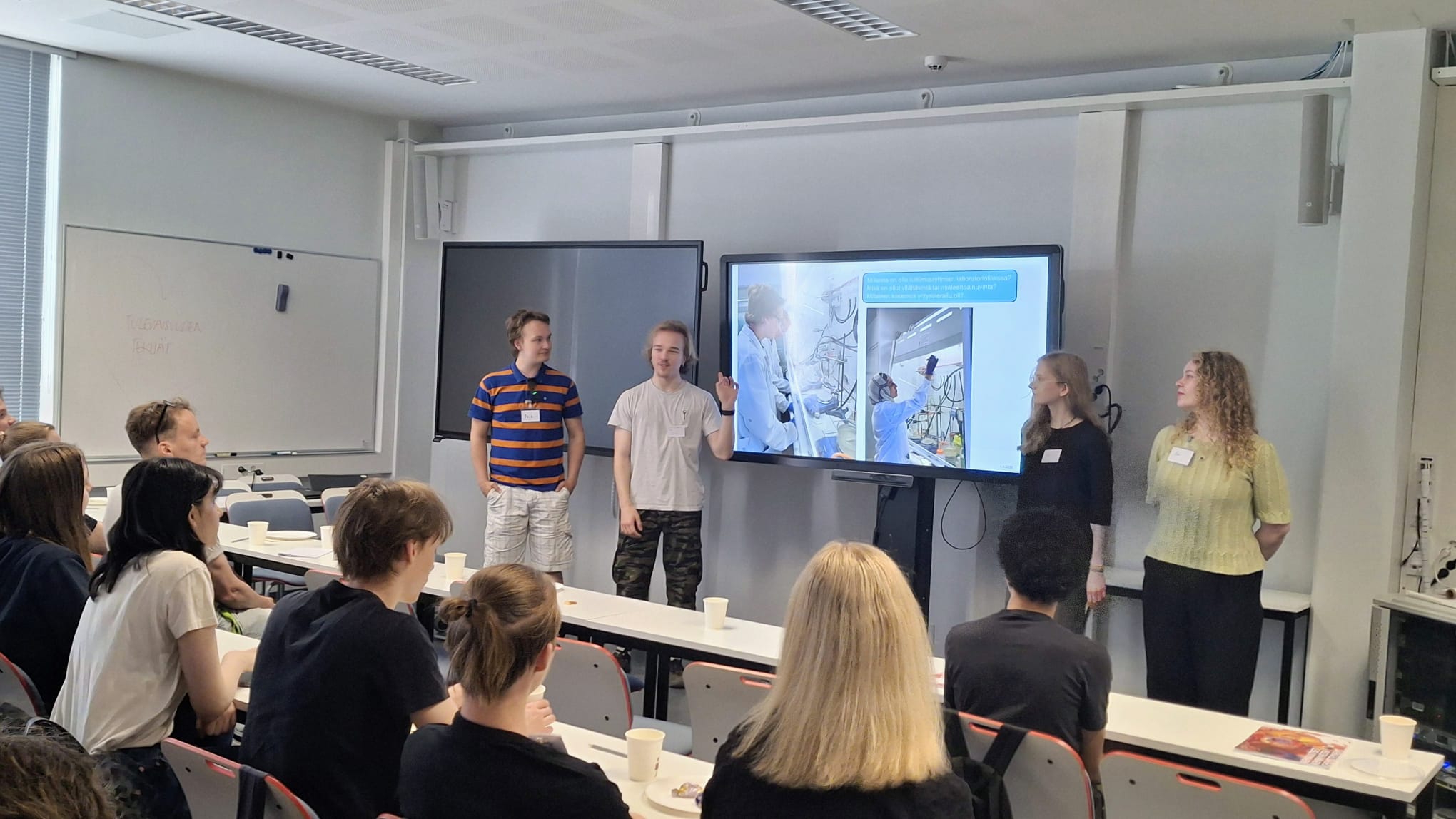
At the beginning of June, the University of Helsinki’s Kumpula Campus hosted the first-ever LUMA Stars Camp, bringing together young people, teachers, researchers, and experts to engage with research and a sustainable future. The camp is part of the new LUMA Stars programme, which aims to strengthen young people’s scientific literacy and agency. A total of 25 participants aged 15–18 and four teachers took part in the summer camp.
A co-created, research-based operating model
The LUMA Stars programme is part of the research and development activities of LUMAlab Gadolin at the University of Helsinki. Its goal is to develop new, research-based operating models in which young people are not only participants, but also active co-creators of the programme’s content.
In the programme, young people act as science ambassadors who explore research and communicate it to other young people. The activities connect the research community, schools, and companies, while also making use of non-formal learning environments. A key component of the programme is the LUMA Stars Camp, organised for the first time in June 2026, which brings participants into the research environments of the Kumpula Campus. Other forms of activity include SCIENCE-TET placements in research groups and the national LUMA Stars online club.
Preliminary results from the pilot implemented during the 2025–2026 academic year suggest that a collaborative, research-based approach supports young people’s learning in diverse ways and increases their understanding of the importance of science and their own ability to influence the future.
The LUMA Stars programme is implemented in collaboration with research groups at the University of Helsinki, the LUMA Centre Finland network, schools, and companies. The programme is guided by a steering group consisting of researchers, teachers, and representatives of partner organisations. In addition, the young people involved in the 2025–2026 pilot actively participate in the planning and implementation. This collaboration enables participants to explore sustainability from the perspectives of science, education, and working life simultaneously.
Bringing research closer to young people
The three-day camp offered participants a unique opportunity to explore current research and its practices. The programme included interactive lectures on topics such as climate change, the circular economy, and sustainable solutions, as well as visits to research groups at the University of Helsinki.
A central part of the camp consisted of small-group visits to research groups. Participants explored topics such as the hydrogen economy, biomaterials, and programming, and examined research through guided tasks. During the visits, they reflected on questions such as which sustainability challenges the research addresses, how research progresses, and what kinds of career paths researchers have. The visits were based on active participation: young people observed research environments, documented what they learned, and compiled their insights for shared use.
The programme addressed key contemporary sustainability-related research topics, including carbon dioxide capture and utilisation, hydrogen economy and clean energy solutions, biomaterials and 3D printing in medicine, and programming. In addition to research group visits, these topics are also explored in content produced by the participants themselves, which is shared with other students, for example, through the online club during the academic year.
Experimental work and collaborative learning
The camp also included experimental laboratory work at LUMAlab Gadolin, located at the University of Helsinki’s Department of Chemistry. In addition, the programme involved joint discussions, reflection sessions, and an introduction to the Kumpula Campus and its study opportunities.
A strong sense of community was at the heart of the camp. Participants were encouraged to engage in active discussion and ask questions, and learning was deepened through sharing experiences and insights.
A key principle of the LUMA Stars programme is the active role of young people. They are not only participants, but also contribute to developing the programme content and produce materials that can be shared with other young people, for example, through the online club. The programme aims to strengthen young people’s scientific literacy, critical thinking, and understanding of research processes and the development of innovations. At the same time, participants gain experience of how science and technology can be used to address societal challenges.
Further information
Director, Professor Maija Aksela
maija.aksela@helsinki.fi
LUMAlab Gadolin
Coordinator Maikki Roiha
maikki.roiha@helsinki.fi
LUMAlab Gadolin
More information about the camp and the programme is available on the University of Helsinki’s science education website (in Finnish).
Read more about LUMA Stars from our news article LUMA Stars – Inspiring young people to shape a sustainable future.