A Dynamic Vision for Finnish STEM Education

Valokuvassa opettaja näyttää kahdelle alakouluikäiselle, miten USB-mikroskooppi toimii. He ovat luonnossa ja työskentelevät kannettavalla tietokoneella.

In May 2026, LUMA Centre Finland approved its renewed Vision and Strategy 2030. It is a forward-looking roadmap that redefines how science education can inspire, include, and empower the next generation across Finland. Built through extensive collaboration across the national LUMA network and aligned with key European and global competence frameworks, the strategy represents a holistic and systemic approach to STEM and STEAM education, where “A” stands for All Sciences.

A Living Strategy Built Together

The new strategy is not a static document. It is the result of broad co-creation, involving universities, schools, policymakers, and stakeholders from across sectors. It integrates national goals, such as Finland’s LUMA strategies and teacher education vision, with international frameworks, including digital, green, and emerging STEM competence models.

This collaborative process ensures that the strategy responds not only to current educational needs but also anticipates future challenges. It positions LUMA Centre Finland as an active builder of learning ecosystems rather than a single actor. It bridges research, education, and working life in a continuously evolving environment.

A Vision Rooted in Curiosity and Inclusion

At the heart of the vision is a simple but powerful idea: every child and young person should have the opportunity to explore, experiment, and discover science in ways that are meaningful and inspiring.

The strategy envisions a nationwide, inclusive learning environment supported by a vibrant teacher community and enriched by encounters with science in multiple contexts. It acknowledges that learning happens everywhere across formal education, informal settings, and everyday life, and seeks to connect these into a coherent whole.

By strengthening the role of science in society, the vision also underlines the importance of scientific literacy as a foundation for democracy, well-being, and innovation.

Responding to a Changing World

The Strategy 2030 is explicitly future-oriented, even though adjusted now foremost to the existing national STEM strategy time interval. LUMA Centre Finland currently has a mandate from the Ministry of Education and Culture for a national task to support and develop Finnish STEM education till 2028. Nevertheless, the strategy has a focal horizon far beyond the upcoming years as it aligns itself with the long-term targets of the national teacher education vision 2050.

The strategy addresses two defining global challenges: digital transformation and planetary sustainability. Rather than treating these as separate themes, LUMA Centre Finland integrates them into a broad STEAM framework. This means combining mathematics, natural sciences, technology, and all sciences with interdisciplinary thinking, creativity, and societal relevance.

Through this approach, learners are encouraged not only to acquire knowledge but also to develop the skills and mindsets needed to solve complex, real-world problems from climate change to technological disruption.

A Systemic Approach Across the Learning Continuum

One of the defining strengths of the strategy is its system-wide perspective. LUMA Centre Finland already reaches over 175,000 participants annually across Finland, spanning early childhood education to higher education and lifelong learning environments.

The new strategy builds on this foundation by strengthening connections across all levels of education and beyond. It promotes:

  • Seamless learning pathways from early curiosity to advanced expertise
  • Integration of formal, informal, and non-formal learning environments
  • Equal access to high-quality science education regardless of location or background

This systemic approach ensures that STEM and STEAM education are accessible, continuous, and impactful throughout life.

Five Strategic Pillars for Impact

The implementation of the vision is guided by five interconnected strategic priorities:

  1. Inspiring children and youth by expanding engaging and accessible learning opportunities across Finland
  2. Increasing societal awareness of the importance of STEM/STEAM skills and career pathways
  3. Strengthening educator expertise through research-based continuous professional development
  4. Advancing research-based teaching and the use of emerging technologies in learning
  5. Deepening partnerships and co-creation across sectors and internationally

Together, these priorities form a dynamic framework that supports both immediate actions and long-term transformation.

Teachers, Networks, and Co-Creation at the Core

A key driver of success is the emphasis on teachers and educators as change-makers. The strategy highlights continuous professional learning, modern pedagogy, and strong links to research and working life.

Equally important is the role of networks and partnerships. By working closely with universities, research institutes, industry, NGOs, and the public sector, LUMA Centre Finland ensures that educational content remains relevant in a rapidly changing world.

This collaborative model transforms science education into a shared societal project, where innovation emerges from interaction between disciplines and sectors.

Building the Future, Together

The Vision and Strategy 2030 is more than a plan -it is an invitation. It calls on educators, researchers, students, and partners to join in building a future where science education is inclusive, inspiring, and deeply connected to society.

By supporting curiosity, strengthening competencies, and fostering collaboration, LUMA Centre Finland contributes to a Finland that is more innovative, sustainable, and resilient.

Together, we are shaping an ecosystem where every learner can grow into a confident problem-solver: Where STEM becomes STEAM, embracing all sciences as part of a shared journey toward the future.

Empowering Future Changemakers: LUMA Stars Camp Connects Youth with Research and Sustainability

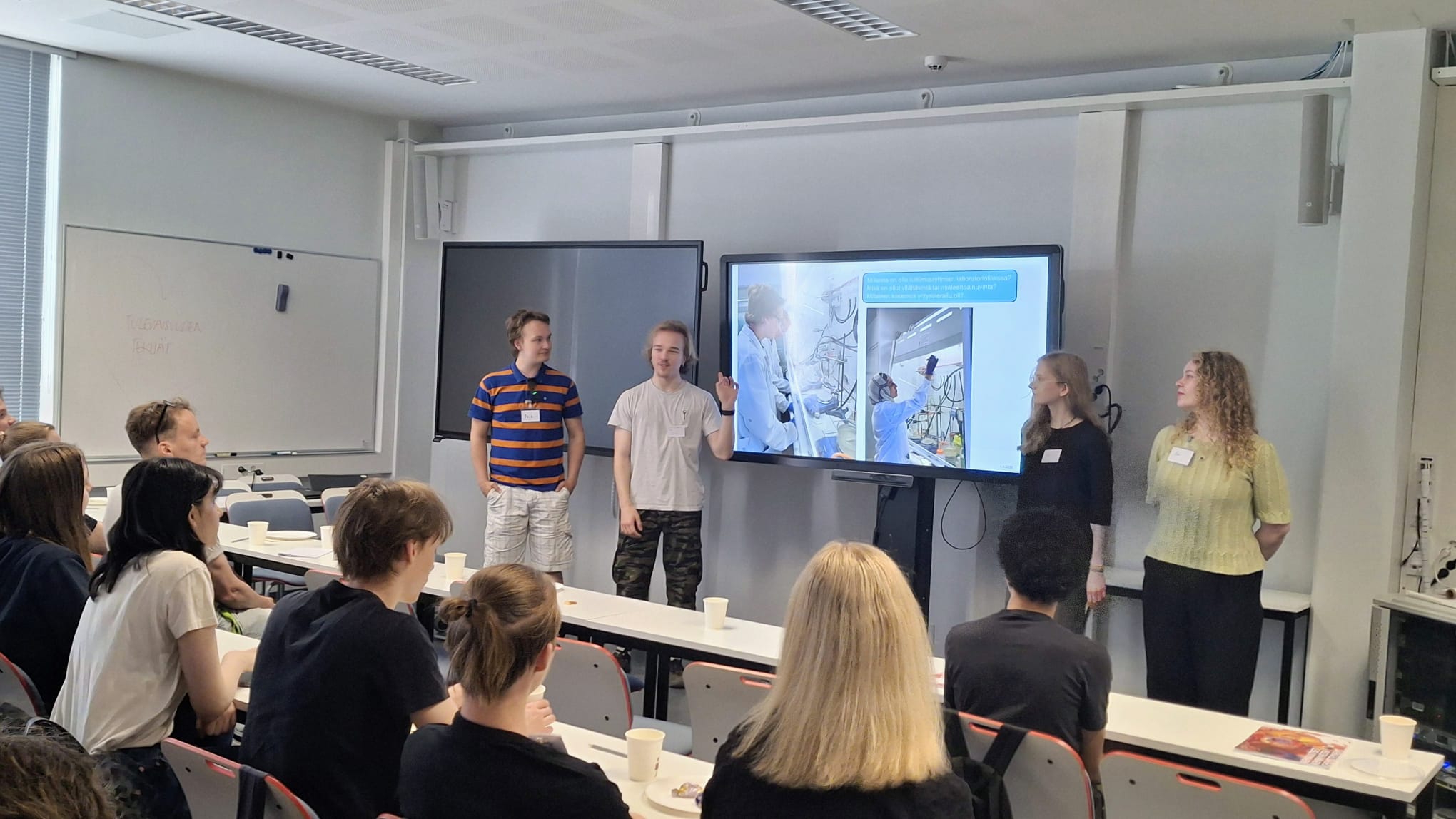
Valokuvassa neljä leiriläistä esittelemässä LUMA Stars -ohjelmaa.

At the beginning of June, the University of Helsinki’s Kumpula Campus hosted the first-ever LUMA Stars Camp, bringing together young people, teachers, researchers, and experts to engage with research and a sustainable future. The camp is part of the new LUMA Stars programme, which aims to strengthen young people’s scientific literacy and agency. A total of 25 participants aged 15–18 and four teachers took part in the summer camp.

A co-created, research-based operating model

The LUMA Stars programme is part of the research and development activities of LUMAlab Gadolin at the University of Helsinki. Its goal is to develop new, research-based operating models in which young people are not only participants, but also active co-creators of the programme’s content.

In the programme, young people act as science ambassadors who explore research and communicate it to other young people. The activities connect the research community, schools, and companies, while also making use of non-formal learning environments. A key component of the programme is the LUMA Stars Camp, organised for the first time in June 2026, which brings participants into the research environments of the Kumpula Campus. Other forms of activity include SCIENCE-TET placements in research groups and the national LUMA Stars online club.

Preliminary results from the pilot implemented during the 2025–2026 academic year suggest that a collaborative, research-based approach supports young people’s learning in diverse ways and increases their understanding of the importance of science and their own ability to influence the future.

The LUMA Stars programme is implemented in collaboration with research groups at the University of Helsinki, the LUMA Centre Finland network, schools, and companies. The programme is guided by a steering group consisting of researchers, teachers, and representatives of partner organisations. In addition, the young people involved in the 2025–2026 pilot actively participate in the planning and implementation. This collaboration enables participants to explore sustainability from the perspectives of science, education, and working life simultaneously.

Bringing research closer to young people

The three-day camp offered participants a unique opportunity to explore current research and its practices. The programme included interactive lectures on topics such as climate change, the circular economy, and sustainable solutions, as well as visits to research groups at the University of Helsinki.

A central part of the camp consisted of small-group visits to research groups. Participants explored topics such as the hydrogen economy, biomaterials, and programming, and examined research through guided tasks. During the visits, they reflected on questions such as which sustainability challenges the research addresses, how research progresses, and what kinds of career paths researchers have. The visits were based on active participation: young people observed research environments, documented what they learned, and compiled their insights for shared use.

The programme addressed key contemporary sustainability-related research topics, including carbon dioxide capture and utilisation, hydrogen economy and clean energy solutions, biomaterials and 3D printing in medicine, and programming. In addition to research group visits, these topics are also explored in content produced by the participants themselves, which is shared with other students, for example, through the online club during the academic year.

Experimental work and collaborative learning

The camp also included experimental laboratory work at LUMAlab Gadolin, located at the University of Helsinki’s Department of Chemistry. In addition, the programme involved joint discussions, reflection sessions, and an introduction to the Kumpula Campus and its study opportunities.

A strong sense of community was at the heart of the camp. Participants were encouraged to engage in active discussion and ask questions, and learning was deepened through sharing experiences and insights.

A key principle of the LUMA Stars programme is the active role of young people. They are not only participants, but also contribute to developing the programme content and produce materials that can be shared with other young people, for example, through the online club. The programme aims to strengthen young people’s scientific literacy, critical thinking, and understanding of research processes and the development of innovations. At the same time, participants gain experience of how science and technology can be used to address societal challenges.

Further information

Director, Professor Maija Aksela
maija.aksela@helsinki.fi
LUMAlab Gadolin

Coordinator Maikki Roiha
maikki.roiha@helsinki.fi
LUMAlab Gadolin

More information about the camp and the programme is available on the University of Helsinki’s science education website (in Finnish).

Read more about LUMA Stars from our news article LUMA Stars – Inspiring young people to shape a sustainable future.