New videos about multidisciplinary, puzzling and topical sustainability issues to lower secondary school

There are many sustainability related themes to address in schools today. What to teach about microplastics? What about the complexity of climate change? Do you students know what humus is? Do they understand how microparticles affect the climate? How are make-ups affecting clericalization?

The new videos will help you address many sustainability issues with your students. The videos are primarily aimed for middle school students (grade 7–9), but can be useful teachers’ tool also for teachers working with younger or older students.

The videos, created by Rooted Education, i.e. Dr. Marianne Juntunen and Dr. Sakari Tolppanen, together with experts in the field, were created to provide easy-to-use video material for classroom use. Each video contains both facts and a call-for-action. The actions range in difficulty, but are created so that they can be done by middle-school students.

The videos touch on many of the global challenges of today. These challenges include climate change, land use changes, extinction of species and the disturbance of nitrogen and phosphorus cycles, to mention a few (Rockström et al., 2009). In many of these we have already exceeded our planetary boundaries (Steffen et al., 2015) and scientists have pointed out that mitigative actions must be taken rapidly (Rockström et al., 2009). That is also the message these videos portray.

The videos address important environmental issues that are not extensively addressed in school education. Dealing with such issues can increase students’ environmental awareness and interest in studying natural sciences. (Juntunen, 2015) In addition, these topics can motivate those students who are typically not interested in science and math.

Though these themes are challenging to deal with, they are important also because they will provide many job opportunities in the future. It is important to deal with these wicked problems in school with a holistic approach, where action competence is at a central role (Juntunen, 2015, Tolppanen 2015).

The videos, funded by the Magnus Ehrnrooth Foundation, can be found on the Youtube.

References

Juntunen, M. (2015). Holistic and Inquiry-Based Education for Sustainable Development in Chemistry.

Rockström, J. (2009). A safe operating space for humanity. Nature, 461, 472–475.

Steffen, W., et al. (2015). Planetary Boundaries: Guiding human development on a changing planet. Science, 347.

Tolppanen, S. (2015). Creating a Better World: Questions, Actions and Expectations of International Students on Sustainable Development and Its Education.


Text and pictures: Rooted Education.

Call for Presentations for the LUMAT 2019 Symposium

LUMA Centre Finland has the honour and pleasure to invite current and prospective math, science and technology teachers from all educational levels, teacher educators and researchers, developers and other experts to Jyväskylä, Finland, from 5th to 6th June 2019, to the International LUMAT Symposium: Research and Practice in Math, Science and Technology Education (LUMAT) 2019.

The theme of the symposium is Future of Work, Research and Education in the context of math, science and technology education.

The call for presentations for LUMAT 2019 is open

Please note that only oral presentations given live at the symposium venue are possible. The LUMAT symposium is free of charge, however we will not cover any travel costs of presenters.

Form for submitting the proposals for LUMAT 2019

The deadline for submitting the proposals is February 3rd, 2019.

The proposals are evaluated by the local scientific sub-committee. The submitters will receive information about acceptance of their presentations by February 15th, 2019.

The registration to the symposium starts on March 2019.


Photo: Sakari Tolppanen.

LUMA Centre Finland receives an international STEM education award

In the photo from left to right: Director prof. Maija Aksela, StarT international project manager Anette Markula, Chair of the board prof. Jan Lundell, StarT national project manager Outi Haatainen. Photo: IPN.

We are proud to announce that the StarT programme has been awarded in an international competition that seeks best practices for education and working life collaboration!  

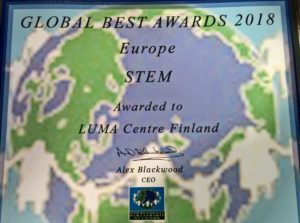
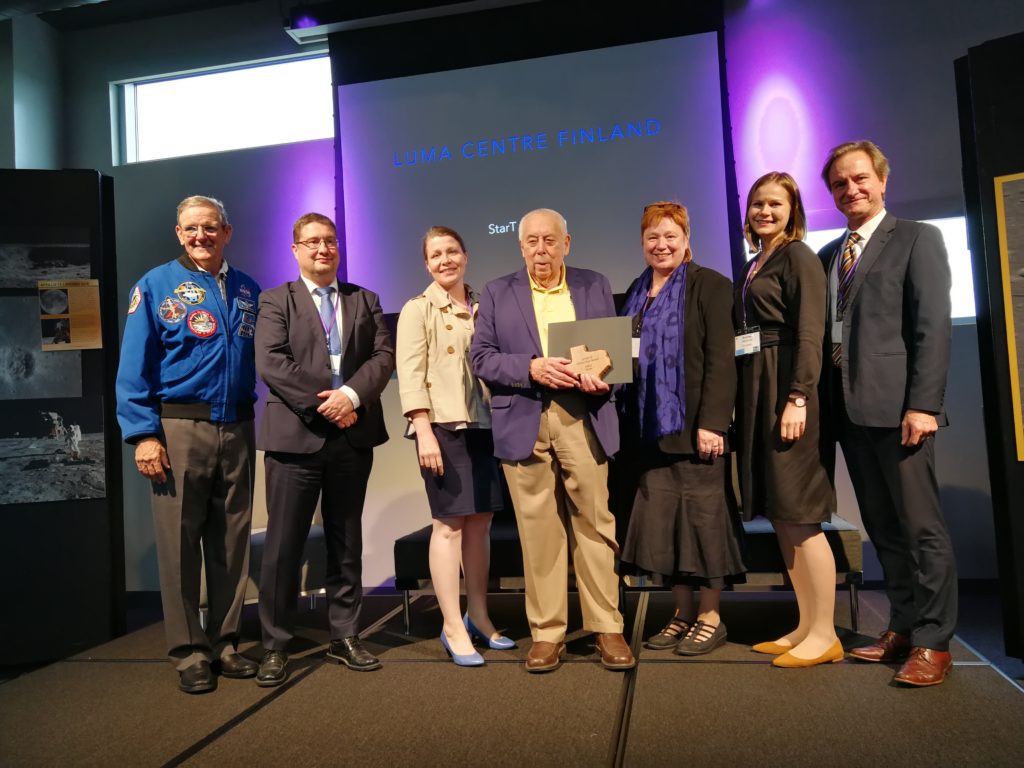
StarT is a science education programme by the LUMA Centre Finland and it has now been granted the Global Best Awards 2018 as Europe’s best programme bridging the gap between working life and STEM education at schools. The award ceremony took place in Houston, Texas at the International Partnership Network (IPN) conference. The IPN is an international education and working life partnership network.

The Global Best Awards 2018 winners were chosen around the world in six categories, and StarT was awarded as Europe’s best in the STEM (”Science, Technology, Engineering and Mathematics”) category. The award was also granted to the Norwegian “Girls and Technology” project. The criteria for the award was that the winner engages young people to STEM related careers and improves their employability in these fields.

StarT is an international and collaborative education initiative in which everyone learns together through interdisciplinary project-based learning. StarT supports children and youngsters and teachers with their science, technology and mathematics projects on all levels of education internationally.

The Director of the LUMA Centre Finland, professor Maija Aksela from the University of Helsinki considers the prize as a remarkable recognition for Finnish science education.

– This international award is a fantastic recognition for the LUMA Centre Finland – a network of 11 universities – for our collaborative and international operational culture. In our initiatives the newest findings from research are creatively transformed into initiatives that benefit children and youngsters, the stars of the future. In StarT we learn from each other through different cultures and create together a better world, Aksela says.

LUMA Centre Finland launched the StarT programme together with their partners in honour of Finland’s centenary in 2016 with the President of Finland, Sauli Niinistö as the official patron of the programme. Annually over 50 cooperation partners of LUMA Centre Finland have contributed to the programme. The signing up for this year’s StarT is now open on StarT’s webpage. Since 2016 the StarT participants have been from over 40 countries around the world.

We want to thank all our collaboration partners and participants! 

More photos from the conference

More information:

Director, professor Maija Aksela, LUMA Centre Finland / University of Helsinki
Phone: +358 50 514 1450
Email: maija.aksela@helsinki.fi
Twitter: @akselamk

StarT international project manager, Anette Markula
Phone: +358 50 311 80 15
Email: anette.markula@helsinki.fi

The representatives from LUMA Centre Finland receiving the award in the Houston Space Centre. In the photo from left to right: astronaut Bill McArthur, Jan Lundell, Outi Haatainen, Johnson Space Center’s former director George Abbey, Maija Aksela, Anette Markula and the chair of the IPN2018 conference Bruce Van Dyk. Photo: IPN.

Join us in carrying out exciting projects and sharing the joy of learning! Participate in StarT 2018-19! 


Have you checked out our online courses on project-based learning yet? Participate here!


Our new international online courses on project-based learning are open!

Our first international StarT online course for teachers, “Introduction to project-based learning through StarT” is open now. In this free course you will learn the basics of project-based learning through LUMA Centre Finland’s education initiative, StarT. The course will prepare you to carry out StarT projects with your students, and provide you with materials, support and tips.

The course will give you an overlook on project-based learning as a teaching method, and show you how the StarT model supports you in carrying out project-based learning that is exciting and interesting for learners. This course also gives you a chance to network and exchange ideas with other teachers from around the world!

The completion of the course is estimated to be approximately 4 hours, and it is entirely self-paced and open all the time (until June 2018). You will receive a certificate after completing the course. The tasks on the course include readingwatching videosconversations with the other participants and short questionnaires.

N.B. The signing up for our second online course “Project-based learning and the theory behind it – create your own project” is now open, too: Register and learn more about project-based learning!

Sign up now here! 


Text: Anette Markula. Photo: Tuuli Holttinen / Julia Uusoksa. Updated on October 21st, 2018.

Learn everyday chemistry in novel ways in ChemistryLab Gadolin

The ChemistryLab Gadolin launched ten years ago, can interest children and young people in science through novel solutions and pedagogical innovations, as well as educate teachers in them. The work of ChemistryLab Gadolin has received international acclaim, as well. 

Chem­istryLab Gad­olin

The first decade of the ChemistryLab Gadolin is celebrated with the publication of a commemorative volume, Collaborative Science Education at the University of Helsinki: ChemistryLab Gadolin – A Science Lab as an Inspiring Environment for Learning, Development and Research since 2008.

School classes can visit the ChemistryLab Gadolin. At the same time, their teachers can learn about new chemistry-teaching methods and innovations during visits conducted by future teachers.

Also the experts within the education field etc. may visit the centre. Usually these visits include a presentation of the collaborative ecosystem and of the activities on general level. Visit might also include observation of the activities in one of the science labs.

In addition to the ChemistryLab Gadolin, there are four other science labs in operation on the Kumpula campus at the University of Helsinki, and one at the Viikki campus.

There are a total of 14 science labs in the national LUMA Centre Finland network.

Ten years ago, something completely new was born on Kumpula campus – the first science lab in Finland, ChemistryLab Gadolin. It has clearly met a demand, as 50,000 visitors have already participated in the class in ten years – children, teenagers, teachers, and others interested in the subject. The class has had over 2000 international visitors. Ever since, a total of 14 LUMA Centre Finland science labs have been established in Finland. Five other science classes are operating at the University of Helsinki.

The ChemistryLab Gadolin, now entering its pre-puberty, looks for new research-based ways to interest children and teenagers in science. In addition to the activity-based school visits, meetings with researchers, and science clubs and camps, areas for development and research include the popular science parties, where you can learn about jumping molecules or flee an escape room with the help of chemistry.

“In the ChemistryLab Gadolin, children and teenagers get to do things and test them. The goal is for them to experience comprehension and the joy of success in the subject of chemistry,” says Maija Aksela, director of the ChemistryLab Gadolin and the Science Education Centre at the University of Helsinki.

At the popular science parties you can learn about jumping molecules or flee an escape room with the help of chemistry.

In a wider context, the goal of Gadolin is to develop and study engaging science education in chemistry and teacher education. Theses and scientific publications are made about the work.

“The tight bond between education of chemistry teachers and the activities of ChemistryLab Gadolin has received international acclaim and has been copied elsewhere,” says Aksela.

Busi­ness life and re­search­ers in co­oper­a­tion

In the near future, Gadolin will bring chemistry even closer to the day-to-day life of children and teenagers through novel solutions. Its themes include everyday chemistry, sustainable chemistry and development, as well as modern technology.

Gadolin is developing new activity-based pursuits in cooperation with university researchers and with business life. Gadolin has 13 corporate collaboration partners.

Gadolin has already offered shared clubs and camps for grandparents and grandchildren.

“In practice, the engaging activities in the chemistry lab include novel green and sustainable chemistry, for example, or medical chemistry, combining chemistry and art in different ways, or using a 3D printer,” Aksela says.

The science education in chemistry also involves the whole family over several generations. Gadolin has already offered shared clubs and camps for grandparents and grandchildren, and is trying to organise more.

“Family science education is one of our research and development targets that has aroused much interest in China, among other countries,” says Aksela.

The ChemistryLab Gadolin belongs to the Science Education Centre at the University of Helsinki, which turns 15 this year.

What do chil­dren and teen­agers say after vis­it­ing Gad­olin?

“I learned new stuff, it was fun.”
“It helped me understand chemistry better.”
“I know more about the opportunities for studying chemistry now.”
“I learned things that I’ll need in upper-secondary school.”
“I learned what it’s like at the university and to study chemistry.”
“I learned about everyday things and their connection to chemistry.”
“I got to make experiments in a laboratory with proper instruments.”

Text: Tiina Palomäki. Photo: Veikko Somerpuro.

New issue of LUMAT on educational experiences related to out-of-school learning

The new special issue of LUMAT: International Journal on Math, Science and Technology Education assembles eight international articles on educational experiences related to out-of-school learning. Articles highlight the relevance of out-of-school learning opportunities from two main perspectives.

The first perspective considers the teachers’ views and perceptions about the facilitators and constraints of out-of-school learning, and likewise the process of changing these views among science student teachers and in-service teachers. The second perspective constitutes of studies exploring science and mathematics learning opportunities in applied out-of-school settings such as science camps, exhibitions, Olympiads and photography galleries.

The Guest Editors of the issues are Valeria M. Cabello (Pontificia Universidad Católica de Chile, Chile) and Vesna Ferk Savec (University of Ljubljana, Slovenia).

LUMAT 6(2) »

Text: Johannes Pernaa. Photo: Kindergarten Metsäpolku.


LUMAT invites researchers, practitioners and educators to contribute to the upcoming special issue on Educational Design Research »

LUMA Centre Finland starts cooperation with Jordanian partner

The LUMA Centre Finland (LUMA) starts cooperation with Innovation for Creativity Development Association (ICDA), a Jordanian non-profit association concerned with the development of the capacities of children and youth through the provision of various academic, technical, social and educational services, especially in the areas of talent, creativity and innovation.

ICDA aimes also to improve students’ attitude towards science and supports their practices of scientific methodology, project-based life-long learning, critical thinking, problem solving and communication skills. It also seeks to enable teachers, students, and supervisors to manage and conduct science, math and technology projects.

LUMA and ICDA have agreed to exclusively work on 2018–2022 on the following projects, namely, to

  1. set up pre-service and in-service training programs for science and math teachers in Jordan
  2. organize the Jordanian LUMA Camps, symposiums, and other training programs like innovation in electronics, chemical green industries, etc. for teachers and for students
  3. conduct research and publish it in collaboration with the LUMA Centre Finland
  4. set up the LUMA Centre Amman.

The winners of the International LUMA StarT Awards of 2018 are Turkey, Portugal, Jordan and Finland

Internationally three most distinguished science, technology and mathematics related StarT projects by young people and three best StarT educational practices by educators were awarded at the International LUMA StarT Gala 2018 in Tampere, Finland, today. The winning teams came from Turkey, Portugal, Jordan and Finland. The Director General of the Finnish National Agency for Education, Mr. Olli-Pekka Heinonen, handed the awards.

The winning projects have provided ideas on how mining accidents could be prevented by programming a safe helmet, and on how students can educate each other on climate change through their own club. One of the winning projects showed how kindergarten children can actively learn about history by doing same things people in the Stone Age did, during all of the school year.

International LUMA StarT Award 2018 (best projects by students)

Baret Care”, students Halil Ataberk Bakırcı, Ahmet Efe Bakırcı and others, Turkey

EcoChange”, Agrupamento de escolas de Alcanena, students Bárbara Correia, Catarina Naia, Guilherme Santos, José Coutinho and Maria Farinha, Portugal

Jump into the life at the Stone Age: Winter” (Hyppy kivikauden elämään: talvi), Day Care Center Piilometsä, Finland

The winning best educational practices showed how to make true real-life connections in secondary school mathematics, how kindergarten children can be real researchers and gave an example of creating a culture of scientific and technological learning in a country. In their evaluation criteria, the StarT jury has focused on innovativeness, interdisciplinarity, collaboration and creativity.

International LUMA StarT Education Award 2018 (best educational practices of instructors and teachers)

Innovation for Creativity Development Association, Suraaya Ayyad, Jordan

MEF Middle School, Simge Sohtorik, Turkey

Preschool group Puuhiset Satulaiva, Kirsi Rehunen, Finland

The International LUMA StarT Awards were awarded for the second time.

The StarT gala is organized by LUMA Centre Finland, a network of all Finnish science and technology universities with a common goal of promoting science, mathematics and technology education on all grade levels.

In 2017-2018, 500 project teams and 100 best educational practices from 20 different countries have participated in the StarT programme of LUMA Centre Finland.

“The key to success is curiosity, creativity and collaboration. They are needed to conquer the wicked problems of our times. The participants of the Start projects have demonstrated all these characteristics and skills which will benefit them in all areas of life in the future.” Director General for the Finnish National Agency for Education, Mr. Olli-Pekka Heinonen

The public’s most voted favourites and the most active countries were also awarded. In addition, the Finnish national awards were handed.

The public’s favourites

Public’s favourite project:

Waste Busters” with their project “Lemna grinder”, students Zeynep Sude Çetin, Bora Özkan, Zeynep Eyüpoğlu, Berfin Elçin, Kerim Berber, Umay Eskialp, Melike Damla Özdemir, Aslıhan Eşkin, Gizem İdil Tunçbilek and Bilgesu Gökçenur. Turkey.

Public’s favourite best practice:

StarT Day in S.O.S. Project Schools” S.O.S. Project Schools, Turkey.

The most active countries

The most active countries out of the 20 countries participating in the StarT programme in 2017-2018 were Turkey and Estonia.

Turkey has registered the most StarT projects, and Estonia has organized a national StarT Science Festival.

Additional information

The composition and the comments of the StarT jury 2018.

Director of the LUMA Centre Finland network and of the StarT programme, Professor Maija Aksela, University of Helsinki, Finland, info@start.luma.fi.

Text: Anette Markula. Photo: Lauri Vihma.

The registration for the StarT 2018-2019 is now open

[wpdevart_youtube]YK8aMXGBihw[/wpdevart_youtube]


StarT provides everyone participating with fresh ideas and support for carrying out projects related to science, mathematics or technology.

We invite schools, kindergartens and extracurricular activity groups from all around the world to come and share with us innovative ideas for interdiscplinary collaborative project work!

Watch the video and register now to join the global StarT community!

The International LUMA StarT Award Nominees and public’s favourites 2018 are here!

The International LUMA StarT Award nominees and the public’s favourite have been chosen ‒ get inspired by the top-quality educational practices from all around the world!

The LUMA Centre Finland is proud to share the nominees for the best educational practices and the best projects carried out in learning communities across the world in 2017‒2018. The videos of these twenty nominees introduce educational practices worth noting and suggest inspiring ideas for carrying out project-based learning in schools and kindergartens. Have a look and let the videos of the top contestants of StarT inspire you!

The International LUMA StarT Awards will be awarded for the second time at the University of Tampere on the 5th of June 2018. In StarT, learning communities from all around the world share their interdisciplinary and cross-curricular science-related projects and educational practices with us at StarT, and we share them with the rest of the world. This year, we received altogether 500 project videos and 100 best practice videos from 20 countries. The StarT jury has now decided the final 20 contestants continuing to compete for the International LUMA StarT Awards, and the public chosen their top two favourites.

The results of the public voting

The StarT jury chose approximately 100 project and best practice videos to be included in the public voting of StarT. The public voting was ongoing from the 12th of March 2018 until the 8th of April 2018, and the project Waste bustersand the best practice StarT Day in S.O.S Project Schoolswere able to inspire the greatest number of people. Congratulations on the winners and thanks to everyone who participated! Read more about the videos of the public’s favourite here.

The nominees for the International LUMA StarT Awards 2018

Out of the videos included in the public voting, the StarT jury has now made their decision on the International LUMA StarT Award nominees. There are two award categories in StarT: 1) best educational practices 2) best projects. The StarT jury has chosen ten nominees for the International LUMA StarT Award, which will be given to three teams with the best projects, and ten nominees for the International LUMA StarT Education Award, which in turn is given to three best educational practices. Thus, the nominee videos are the top twenty videos reported to StarT in 2017-2018, and they convey exemplary educational practices that take use of an interdisciplinary approach, and promote collaborative learning and active learning in general. By watching the videos everyone can benefit from the pedagogical innovations formulated across the world, and make use of the exciting ideas and quintessential methods for carrying out project-based learning.

The International LUMA StarT Education Award Nominees 2018 (best practice nominees):

  1. Preschool group Puuhiset Satulaiva, Kirsi Rehunen, Finland
  2. Innovation for Creativity Development Association, Suraaya Ayyad, Jordan
  3. Junior Karasin University; ”Club 2×2″ from Children and Youth Center for Creative Activities, Halyna Hodovana, Ukraine
  4. Kulosaaren Yhteiskoulu (Kulosaari Secondary School), Hanna Huhtakallio, Finland
  5. Team Chimera, Richard Spencer, the United Kingdom
  6. MEF Middle School, Simge Sohtorik, Turkey
  7. MTA-SZTE Science Education Research Group and Arany János Primary School Szeged, Erzsébet Korom, Hungary
  8. S.O.S Project Schools, Nilgün Erentay, Turkey
  9. 1B NMS Stromstraße, Katharina Rettenmoser, Austria
  10. Ylämyllyn koulu (Ylämylly school), Pekka Tarva, Finland

The International LUMA StarT Award Nominees 2018 (project nominees):

  1. “EcoChange”, Agrupamento de escolas de Alcanena (Bárbara Correia, Catarina Naia, Guilherme Santos, José Coutinho and Maria Farinha), Portugal
  2. “Grab group versus shovel group”, Automatic parking robot plan (Xu Mohan, Zhang Shuqin, Han Xinxue, Wang Jieting), China
  3. “UV Alarm”, Clube Ciência Viva ESDMII Braga (Francisco Toldy, Filipe Santos, Raquel Moreira), Portugal
  4. “The Galaxy”, Curious Astronauts (Sabahat Demir, Nergiz Demir, Irmak Acar, Şiyar Atak, Cihan Güngör, Oktay Demir, İsmail Atan), Turkey
  5. “Oma peli ohjelmoimalla (pragramming your own game)”, Jyväskylän normaalikoulun alakoulu (Primary school of the Jyväskylä teacher training school)  (Class 3C), Finland
  6. “Tom Yam Kung Project”, National science and technology development agency (Kindergarten school of Thammasat University), Thailand
  7. “Baret_Care”, Nigde Aksemseddin Science and Art Center (Halil Ataberk Bakırcı, Ahmet Efe Bakırcı and others), Turkey
  8. “Hyppy kivikauden elämään: Talvi” (Jump into the life at the Stone Age: Winter), Day Care Center Piilometsä, Finland
  9. “Lemna grinder”, WASTE BUSTERS (Zeynep Sude Çetin, Bora Özkan, Zeynep Eyüpoğlu, Berfin Elçin, Kerim Berber, Umay Eskialp, Melike Damla Özdemir, Aslıhan Eşkin, Gizem İdil Tunçbilek, Bilgesu Gökçenur), Turkey
  10. “#biopolku” (“#biopath”), Äänekosken lukio (Äänekoski Upper Secondary School)  (Elina Aaltonen, Arttu Hytönen, Liisa Pulli, Linda Savolainen, Santtu Sällinen, Sofia Turunen), Finland


Welcome to the International LUMA StarT Gala on the 5th of June in Tampere, Finland!

The final six winners of the International LUMA StarT Awards will be revealed in the international LUMA StarT gala which is the grand final of both the national and international StarT every year. This year the gala will take place at the University of Tampere on the 5th of June 2018, as a part of the international LUMAT Symposium and the national LUMA Days. The awards will be handed by the Director General of the Finnish National Agency for Education, Olli-Pekka Heinonen. Everyone is warmly welcome to participate in the gala! There gala will also be livestreamed, so that everyone in the world can watch it online.

Remember: registering as a learning community for the StarT 2018–2019 starts in May!

StarT is organized annually, and we invite all learning communities from daycares to upper secondary schools and extracurricular activity groups to share their best educational practices and project-based learning ideas related to science with us! Registering for the StarT 2018–2019 starts in May, and you can find more information here. Registering does not bind you to anything, but instead you will receive additional support and inspiration for carrying out exciting, interdisciplinary project-based learning in your learning community. Welcome along, everyone!

More information about StarT:

  • Director, Professor Maija Aksela, LUMA Centre Finland
  • International project manager, Anette Markula, LUMA Centre Finland


https://start.luma.fi/en/   | info@start.luma.fi   

Evästeasetukset
LUMA-kukka ilman tekstiä

This website uses cookies so that we can provide you with the best user experience possible. Cookie information is stored in your browser and performs functions such as recognizing you when you return to our website and helping our team to understand which sections of the website you find most interesting and useful.

You can adjust all of your cookie settings in this view.

Strictly Necessary Cookies

Strictly Necessary Cookie should be enabled at all times so that we can save your preferences for cookie settings.

Analytics

This website uses Google Analytics to collect anonymous information such as the number of visitors to the site, and the most popular pages.

Keeping this cookie enabled helps us to improve our website.