New climate change education project CLIMATE? about to begin

Concerns and questions about climate are part of everyday discussions in our societies. Also students in schools have questions they seek answers to. They are related to for example scientific, societal, ethical, and moral aspects. Students` questions can be used as part of climate change education in classrooms to make the topic approachable for the students, to activate students to learn, and raise hope for the future. The Finnish national core curriculum has also emphasized the importance of students` questions and climate in education.

LUMA science education centre (part of LUMA centre Finland) launches a research-based climate change education project CLIMATE?, the aim of which is to co-design and test pedagogical models for student-question-based climate change education with teachers all over the world using an online platform. Project is part of a larger research-based climate change education program. Recent years we have organized for example Teachers` climate change forum together with INAR. Project is co-designed with teachers as well as experts, such as assistant professor Dr. Cliona Murphy from Ireland.

During the project, teachers get concrete ideas and examples on how to use students` questions as part of their climate education and discuss with other teachers about their ideas and experiences in the classroom using student-question-based pedagogy. The goal is that teachers` self-efficacy for the pedagogy improves and student-question-based pedagogy in climate change education is developed into new didactic models for teachers all over the world to be able to utilize in their teaching.  

The project begins in October 2020. Teaching models are tested in schools in 2020-2021. More detailed schedule is designed with the participants. There are registered participants from over ten countries already, but you can still join the project by emailing the project leader Jaana Herranen by October 15th 2020 (jaana.herranen@helsinki.fi).

For more info: project leader Dr. Jaana Herranen, or leader of climate change program in LUMA science education professor Maija Aksela, University of Helsinki.

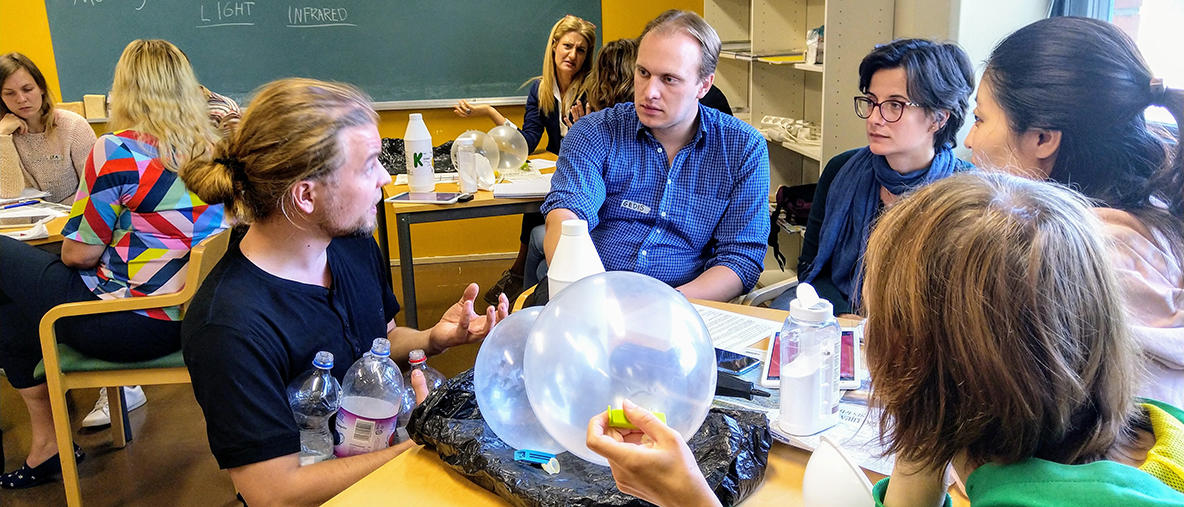
Teachers in our international Teacher Climate Change Forum (TCCF) event learning with researchers in Hyytiälä. 

New professor of science education encourages scientific thinking

As a first in Finland, the University of Helsinki has established a professorship in science education focused on the natural sciences. Professor and Research Director Maija Aksela, DPhil, has been invited to the position. After being found indisputably qualified in an international assessment, she will assume the post as of 1 May.
 

With a 20-year academic career at the Faculty of Science, Professor Maija Aksela is known for her inspiring, innovative and inclusive efforts to promote science education in the natural sciences as well as related teacher training and research in Finland and abroad.

Under Aksela’s direction, LUMA Centre Finland, a network of 13 science education centres, has been established in conjunction with 11 Finnish universities, carrying out a national mission assigned by the Ministry of Education and Culture. The mission of science education in the natural sciences is the enhancement of scientific competence.

Boost­ing science education

The toolbox of research-based science education includes science classrooms, clubs, camps and birthday parties, as well as science videos and online journals. Of equal importance to science education is the provision of inspired teacher training in order for teachers to be able to educate pupils into people who understand science and use its methods. Collaboration with the families of children and adolescents is another integral component.

One of the strategic objectives of the University of Helsinki is to improve the current science education and expand it, through new initiatives, to engage the entire University community. As evidenced by the establishment of the professorship in science education, the goal is to promote science education and science communication.

Currently, a steering group appointed by the rector of the University of Helsinki is drawing up a strategic plan for science education and preparing related operations for the next strategy period.

A power­ful cycle of research, prac­tice and education

Maija Aksela, who describes herself as a catalyst, says that she strives to engender opportunities for future professionals to learn and to make the world a better place. Science education advances critical thinking, problem-solving skills, inclusivity and creativity.

“It’s important to get learners to wonder, enquire and call things into question, just like natural scientists do. The questions ‘why’ and ‘how’ are central to scientific thought and to the promotion of understanding of all kinds,” Aksela says.

In fact, a multidisciplinary research group headed by Aksela has produced a number of international publications and theses on science education, including doctoral dissertations, of which Aksela has already supervised 15 to date. Current research topics include the modelling of contemporary research and future issues in the natural sciences, as well as questions pertaining to climate change.

Aksela considers inclusivity, reliance on research and multidisciplinarity key to science education. Operational models are established in an agile and engaging manner in interaction with students, scientists, children, pupils and the elderly, future and current teachers, families as well as specialists active in professional life, with everyone learning from one another. Indeed, Aksela’s motto is “Together we are more!”

In Aksela’s line of thinking, research, practice and education go hand in hand. She thinks that new solutions and pedagogical innovations required for a sustainable future, such as online courses, can be discovered by examining the practice and theory of science education. Science education also works well as an element of higher education. Together with the practices of continuous learning and teacher training, science education is disseminating the latest knowledge all across Finland.

According to Aksela, skilled teachers play a crucial role.

“The impact of each individual teacher lasts roughly a century; first during their own activity and then, later on, through their former pupils and students. It’s very important for teachers to have the most recent knowledge of the fields of science and how to provide instruction on them.”

Con­tin­ued in­volve­ment in science education

The duty of a professor is to carry out and supervise scientific work, provide education based on it, follow developments in research and participate in societal interaction and international cooperation in his or her field. This is nothing new to Aksela.

For now, Professor Aksela will also continue serving as director of LUMA Centre Finland as well as its LUMAT Science Research Forum. In addition, she will continue serving in roughly 10 national positions or international projects related to LUMA operations, such as the post of editor-in-chief of the International Journal of Math, Science and Technology Education, which she founded.

At the University of Helsinki’s Faculty of Science, she contributes to subject teacher training in mathematics, physics and chemistry as the deputy director of the degree programme. At the Department of Chemistry, she heads the teacher training unit and its science education activities, including the prize-winning ChemistryLab Gadolin.

An award-win­ning aca­de­mic

Aksela’s research career got its start in Canada in the field of computer-assisted modelling (today known as computational chemistry). She is also a trained subject teacher, with experience in the profession after working as a teacher for six years as a young adult. Aksela has published more than 350 articles, some of them co-authored with scholars from 12 different countries. For her contributions, she has been awarded over ten national or international awards, including an award for the natural scientist of the year and the State Award for Public Information.

Professor Aksela is interested in international science education, and she has repeatedly been invited to give addresses to her scientific community, in addition to which she has been an active member of the networks of the scientific journals in the field and has contributed to international cooperation through the Finnish National Commission for UNESCO, working groups of the European Commission and ALLEA working groups relevant to the field. Aksela is one of the invited founding members of the University of Helsinki’s Teachers’ Academy and a member of the national Teacher Education Forum.

Aksela’s hobbies include spending time outdoors and photography, painting, music and visits to her summer cottage. She is interested in different cultures and ways of thinking. At the moment, Aksela is looking back on the past and present highlights and achievements of LUMA science education by writing two books on the topic with her community.

Text is originally published in University of Helsinki’s page.


Welcome to the international LUMAT Research symposium

Welcome to a virtual research symposium on June 3rd – 4th, 2020. The LUMAT symposium is free of charge.

The theme of the symposium is Promoting STEAM in education, in which S stands for Science, T for Technology, E for Engineering, A for All subjects in this case, and M for Mathematics. The symposium invites researchers, teachers, and students to discuss and learn about the possibilities and challenges of STEAM in various and interdiscilpinary perspectives.

Read more and take a look at the preliminary program!

REGISTER HERE!

In­ter­na­tional course for youth on global chal­lenges

The University of Helsinki organizes an international course for youth next time on 2021. The course will not be organized on 2020 due to the corona situation.

The course is based on working with global challenges on four themes:

  • Climate Change
  • Digitalization
  • Circular economy
  • Wellbeing

During the course, the students carry out small learning projects together in teams with the university students and researchers.

The course starts with an intensive period on August in Helsinki, Finland. It continues as an online course after that during early Autumn.

The program of the course is diverse and is built on the basis of the participants’ interests. 

The course itself will be free of charge, but the participants should reserve and pay for their own traveling, accommodation, and meals. 

Read more info here


Welcome to an international summer school

Welcome to the first International LUMAT Research Summer School on 2.6.2020. Due to the corona situation, the summer school will be virtual and free of charge this year. Register by 15.5!

The summer school is organized by LUMAT Science Research Forum within LUMA Centre Finland (national network of 11 Finnish universities) and Finnish Mathematics and Science Education Research Association. The summer school is part of LUMAT Symposium 2020.

The goal of the summer school is to reinforce collaboration among doctoral students, researchers, and teachers and future teachers of mathematics, science, and technology education and to discuss and learn about research according to participants` interests and needs. 

The program of the summer school will be planned by the organization committee taking the participants` wishes and needs into account.

The summer school is led by an organizing committee: Professor Maija Aksela (director of LUMA Centre Finland and its research forum), Dr. Veli-Matti Vesterinen (president of the Finnish Mathematics and Science Education Research Association), Dr. Pasi Nieminen (vice president of the Finnish Mathematics and Science Education Research Association), Dr. Johannes Pernaa (managing editor of LUMAT journal) and, Dr. Jaana Herranen (the coordinator of LUMAT Science Research Forum).

Registration through registration form by 15.5. Please, register here Jaana will answer all further inquiries about the summer school (jaana.herranen@helsinki.fi | +358 294 150 464). 

Warm welcome to LUMAT Research Summer School to learn together!

Maija Aksela, Veli-Matti Vesterinen, Pasi Nieminen, Johannes Pernaa, and Jaana Herranen

MORE DETAILS:

Creating bet­ter world to­gether! 2nd In­ter­na­tional Teach­ers’ Cli­mate Change Forum 2020

How to make better world together through education? How to teach climate change? How to collaborate with scientists in climate change? We welcome you to participate in our international Teachers’ Climate Change Forum! Application period starts at March 1st.

Climate change is one of the biggest global challenges of our time. Teachers have a key role in educating children and youth in their knowledge, skills and attitude. The Science Education Centre and Institute for Atmospheric and Earth System Research (INAR) from University of Helsinki are organizing international and participative Teachers’ Climate Change Forum 2020 – continous professional development program for teachers on all school levels from around the world.

The continuous professional development (CPD) -program consists of two parts. The first part  is the MOOC (Massive Open Online Course). The second part is teachers’ summer course organized in Hyytiälä on August 3rd – 6th, 2020.

TCCF2020 MOOC is open for all and everyone has an opportunity to complete the course.

A maximum of 30 teachers will be selected to participate the Summer Camp. They will also have an extra section available on the MOOC.

The application period for the Summer Camp is from March 1st until March 22nd.

The applicants will be notified whether they have been selected on March 31st, 2020.

The Course will open on the 1st of April and the section for Summer Camp will open at 20th of April.

So, save the date of the Summer Camp and apply on the beginning of the March.

Read more about the pro­gram’s webpage >>
 

Click here to read about last year’s Summer Camp experiences and atmosphere.

LUMAT Special Issue on Educational Design Research is published

During the past few decades, several interconnected research traditions have paid more and more attention to the process of educational design. Educational design research and other design-oriented methods seek complex educational problems through systematic, iterative, and continuing process of design, development, and evaluation of educational practices. This special issue presents six articles including research on educational design research methodology as well as research utilizing educational design research methods.

You can find the special issue on LUMAT-journal.

Editors
Johannes Pernaa, The Unit of Chemistry Teacher Education, Department of Chemistry, Faculty of Science, University of Helsinki, Finland
Veli-Matti Vesterinen, Department of Chemistry, University of Turku, Finland

Doctoral thesis: Learner-driven sustainability education

For a sustainable future, there is a need for science teacher education in which both science and sustainability are taken into consideration. In addition, the needs and hopes of the students should be in core as they are making the decisions in the future.

M.Sc. Jaana Herranen presented her PhD dissertation on learner driven science teacher education for sustainability in the SECO research group. The thesis was written in the Unit of Teacher Education with the guidance of professor Maija Aksela and associate professor Erik Fooladi. The opponent was associate professor Jesper Sjöström from the Malmö University, Sweden.

The thesis argues that learner-centred and learner-driven sustainability education are different constructs, and examined the possibilities and challenges of those approaches. It was noticed that higher education students can plan courses and parts of courses in which they can take the relevant aspects of e.g. sustainability and inquiry in account, although they also faced challenges in their student-led collaborative planning. As a result, a model was also created to support the use of students` own questions in inquiry-based learning.  

Thesis is also in electronic form and you can find it here.
More about research by Jaana Herranen.

International recognition for the StarT programme: invitation to the IDoS-forum in Berlin 

The biannual “International Dialogue on STEM Education 2019” conference takes place in Berlin 5.-6.12.2019. This year the conference focuses on the role of science, technology and mathematics in education for sustainable development during early years education. The central goal of the conference is to bring together initiatives and experts to discuss how STEM education can empower children to contribute to creating sustainable societies. The keynote speakers are Professor Dr Ilan Chabay (Head of Strategic Science Initiatives and Programmes and Scientific Project Leader of the GSSF and KLASICA projects at the Institute for Advanced Sustainability Studies) and Dr Ha Vinh Tho (Former Programme Director of the Gross National Happiness Centre Bhutan and Co-Founder of Eurasia Foundation). Read more about the conference here.

The StarT programme organised by LUMA Centre Finland was invited to the conference as an internationally distinguished example of an initiative that empowers children to use STEM in solving issues related to sustainability. The conference sought out exemplary initiatives from different continents and StarT was chosen to represent Europe together with another initiative. In StarT children and youngsters get to create authentic solutions to issues in their own environment, and as such develop the skills and self-efficacy required from them to be able to contribute towards sustainable societies. However, StarT focuses not only on young people but also on teachers, whose exemplary best practices are shared through the programme. 

StarT will host a workshop at the conference, and in accordance with the motto of StarT the topic will be “sharing the joy of learning”. As such, the workshop focuses on the special expertise of StarT: different ways to share the best practices of teachers and the project work of children and youngsters. In classrooms all over the world, innovative ideas are constantly emerging from small things. But for these innovations to turn into the foundation for global changes, they will need to be brought out of the classrooms for others to see and discover. 

Join in for the next StarT season

You can participate in the international StarT 2019-2020 competition now (participate here). Teachers can participate in the competition by describing the projects they have carried out with children or youngsters, and/or the best educational practice of their learning community until 14.2.2020. The main prize is a trip to Finland. The StarT themes 2019-2020 are: 

  1. Sustainable development (eg. climate change and circular economy)
  2. Mathematics around us (eg. mathematics in art and statistics)
  3. Technology around us (eg. a moving device, artificial intelligence and robotics)
  4. My LUMA (a topic of your choice)

Have a look at our material bank in English for ideas and inspiration for your projects!  

Read also about the international award for StarT-program from the International Partnership Network:  LUMA Centre Finland receives an international STEM education award

New LUMA-program starts: LUMA2020 is about doing together, learning and inspiring

LUMA2020 program, funded by the Finnish Ministry of Education and Culture, starts this autumn in all LUMA Centre Finland’s LUMA Centers all across Finland. The aim is to develop formal education from early childhood education to upper secondary education, as well as science related free time opportunities and technology education activities for children, youth and their families. The program will also support continuous professional development of teachers from early childhood education to higher education through new project learning models and practices. A steering group set up by the Ministry of Education and Culture manages the LUMA2020 program.


A total of 161 learning communities were selected for LUMA2020 program. In these learning communities are formal learning communities such as kindergartens, schools and vocational schools, but also leisure learning communities such as hobby schools. All selected learning communities are presented on the program website.


One of the aims of the program is to disseminate materials and best practices from previous development programs. The best practices and operating models of the LUMA Suomi development program, LUMATIKKA and the StarT-program are collected under four different themes. The themes are Sustainable Development (including Climate Change, Circular Economy), Mathematics Around Us (including Art, Economics and Statistics), Technology Around Us (including Artificial Intelligence, Robotics) and My LUMA (an optional theme that links to STEAM subjects). The aim is to support the work of teachers in implementing the new natural core curriculum. The program provides tools for e.g. to support project-based learning, multidisciplinary learning and different learning communities.


The LUMA2020 program has two phases: a development phase and a dissemination phase. The results will include free online courses (MOOCs) and other virtual opportunities such as virtual clubs for all kindergartens and schools in Finland. The program will provide online education material for teacher and a number of regional meetings over the period 2019-2020. The program culminates with the 16th nationwide LUMA Days at Aalto University June 3 – June 5, 2020, when learning projects and learning communities are presented to the public.

Congratulations to all selected LUMA learning communities!

For more information:
Maija Aksela
Prof., LUMA2020 Program Director, LUMA Centre Finland Director, University of Helsinki
maija.aksela@helsinki.fi

Oona Kiviluoto
Project Manager, LUMA2020 Program, LUMA Centre Finland
oona.kiviluoto@helsinki.fi

Evästeasetukset
LUMA-kukka ilman tekstiä

This website uses cookies so that we can provide you with the best user experience possible. Cookie information is stored in your browser and performs functions such as recognizing you when you return to our website and helping our team to understand which sections of the website you find most interesting and useful.

You can adjust all of your cookie settings in this view.

Strictly Necessary Cookies

Strictly Necessary Cookie should be enabled at all times so that we can save your preferences for cookie settings.

Analytics

This website uses Google Analytics to collect anonymous information such as the number of visitors to the site, and the most popular pages.

Keeping this cookie enabled helps us to improve our website.