LUMAT Call for papers: Sustainability and Education

LUMAT invites researchers, practitioners, and educators to contribute to the upcoming special issue on Sustainability and Education.

Description

Education policy and curricula in various countries emphasize promoting sustainability in all levels of education. Sustainability and Education special issue will focus on research discussing the role of sustainability in education as well as research on promoting sustainability through education. We welcome contributions from all areas of educational research (e.g. science, art and engineering education as well as educational psychology and educational sociology).

Deadlines and special issue timetable:

  • Submission deadline (full paper): October 31, 2022
  • Continuous publication after peer review and acceptance.

We welcome both empirical as well as theoretical manuscripts in English, Finnish, Swedish and Icelandic.

Acceptance criteria for the manuscripts are that they:

  • Are research-based and have not been previously published.
  • Contain the following subsections:
    • Context/relevance of the study: Why the research was conducted.
    • Aim/research questions: What guided the research.
    • Theoretical framework/conceptual rationale/pragmatic grounding: How the current research is connected to the earlier studies.
    • Research methods and research design: How the research was conducted (both empirical and theoretical manuscripts are welcome).
    • Results (in theoretical manuscripts, the discussion on how the manuscript contributes to the earlier research can be combined with the discussion section and Result section might be omitted.
    • Discussion/Conclusions/Implications: How the research questions were answered, how the research results contribute to the field.
    • References in APA 7 style: Use the template on the journal website.
  • Follow the academic research guidelines for ethical and professional academic publishing, such as: publishing original work, accurate and detailed findings and methodology, including those writers as authors that have contributed to the work significantly; including all the permissions to publish previously published content from the copyright holders; adhering to (personal) data protection legislation (confidential information, identifying individuals, etc.)
  • Are clearly written – English clarity and correct grammar are expected. If necessary, the authors are asked to proofread, and copy edit the manuscripts prior to the submission.

General paper submission guidelines

Guest editors

PhD Veli-Matti Vesterinen, University of Turku, Finland
PhD Ásthildur Jónsdóttir, University of Iceland, Iceland

The winners of the LUMA StarT 2022 -Awards were announced in the StarT Gala

The LUMA Centre Finland network awarded the best science and technology projects and teaching practices on Monday 13th of June at the International StarT Gala.

This year, we finally had the opportunity to gather together after a two-year break at the Aalto University, Finland. In the gala, the LUMA Start Award 2022 was given to the three best natural sciences, math or technology related projects done by children and young people. The LUMA Start Education Award 2022 was given to three learning communities for best educational practice in relation to the interdisciplinary project-based teaching. Winners received a trip to Finland in addition to the prizes.

The International LUMA StarT Awards went to:

The StarT honorary jury found the choice incredibly challenging due to the high level of practices and projects. The winning projects took off from real questions and thoughts of children and young people. The projects included cooperation both within their own learning community and also with others. The videos and learning diaries of the projects were first-rate and carefully done.

The International LUMA Start Education Awards went to:

The creators of these practices had demonstrated interdisciplinary and innovative work in their practices. The StarT honorary jury described the practices as pragmatic, inventive and versatile. The jury valued interdisciplinarity, collaboration, and the active inclusion of children and young people in the winning practices.

In the 2021-2022 season a total of 847 project work and 750 educational practices took part in StarT. The joy of learning was shared by 1, 486 learning communities, 6, 912 teachers and 325, 126 children and young people. This season has reached its end but luckily the new season starts right away! Let’s StarT again and remember that learning is sharing!

International LUMAT journal 10th anniversary -over 500 papers processed

LUMAT journal celebrates its 10th year anniversary this year.  Launched in year 2013, the journal has been promoting math, science, and technology education, teacher education and its research.

“Back then, there was a huge need to publish original research articles and conference proceeding written in Finnish, Swedish and English. We also aimed to make math, science and technology education research familiar especially for future teachers and teachers”, says the founder of the LUMAT journal and its editor-in-chief, professor Maija Aksela.

LUMAT journal is proud to publish scientific research from around the world. Authors from dozens of countries have chosen LUMAT as their publishing channel. Since 2013, the journal has processed over 550 manuscripts publishing over 240 articles.

JournalProcessedPublishedDeclined
LUMAT415131284
LUMAT-B13811226
Total553243310
The statistics of the LUMAT journals

In the recent years LUMAT has secured an established position as a science education research journal. We would like to thank our authors, editors, international advisory board and hundreds of reviewers that are listed annually in the LUMAT website.

Only special numbers in the future


From the beginning of August 2022, the journal will change its publishing process. Docent Johannes Pernaa from University of Helsinki will become its editor-in-chief. Dr Mika Koskenoja, Dr Veli-Matti Vesterinen and Dr Johanna Naukkarinen will become the main editors. The LUMAT will only publish special numbers in future. More information about the publishing process will be updated on LUMAT website.

About LUMAT journal

The LUMAT journal is published by the LUMA Centre Finland -network and University of Helsinki.

Today LUMAT Journals consists of two journals, LUMAT and LUMAT-B. Both journals publish
research articles on math, science, and technology education, but with a slightly different scope:
LUMAT is a peer-reviewed journal that publishes original research articles and review articles,
whereas LUMAT-B publishes online books as well as proceedings from conferences, seminars,
and symposia.

LUMAT is indexed in several databases like ERIC, Scopus, DOAJ, Google Scholar, EBSCO,
and Index Copernicus. The managing editor, docent has been Johannes Pernaa for the last
five years.The earlies editors have been Dr Veli-Matti Vesterinen and Dr Sakari Tolppanen.

Authors: Maija Aksela, Johannes Pernaa

Join Teacher’s Climate Change Forum for ideas on your climate education

Do you need ideas for climate education? Would you like to receive the latest information about climate change and climate research? Or would you like to connect with your colleagues all around the world? Join us in August to get all this and more. 

International Teachers’ Climate Change Forum is held virtually on 8.-9. August. The event is targeted to teachers in all levels of education who are interested in climate education. Professional development is supported with a variety of lectures and workshops, where you can discuss and share ideas with other participants. The event is organized with Global Challenges for Youth Forum, allowing for an interesting exchange on climate change between teachers and students.

To learn more and register, see this website.  

Programme

Monday 8th of August, 2022 9.00 -15.00 GMT+2

9:00-9:15 Opening words, director of TCCF, professor, Maija Aksela, LUMA Science Helsinki

9:15-9:30 Practical info, coordinator, project designer, Pinja Tolvanen

9:30-11:00 Keynote lecture and group discussions: “Facts about climate change”, University lecturer, Laura Riuttanen, INAR

11:00-12:00 Break

12:00-14:00 ClimatEscape – Interactive climate narrative, Doctoral researcherJanina Taurinen, INAR

14:00-14:15 Break

14:15-15:00 Experiences and ideas of good climate change activities

15:00-15:30 Summary of the day, University lecturer, Taina Ruuskanen, INAR

Tuesday 9th of August, 2022 9.00 -16.30 GMT+2

9:00-9:10 Opening words, director of TCCF, professor, Maija Aksela, LUMA Science Helsinki

9:10-9:15 Practical info, coordinator, project designer, Pinja Tolvanen

9:15-11:00 Keynote lecture and group discussions: “Students’ agency and climate change”, Senior researcher, Sakari Tolppanen, University of Eastern Finland

11:00-12:00 Break

12:00-16:00 Multidisciplinary workshops:

12:00-13:00 Geography and Environmental Change: Educational Example of Taita Hills, Kenya. LUMA Taita -project, Pinja Tolvanen

13:00-14:00 How to teach about climate based on learners’ questions?, Climate? -development project, director of TCCF, professor, Maija Aksela, LUMA Science Helsinki

14:00-15:00 Open Climate Data – How to use the new IPCC Interactive Atlas, Doctoral researcher, Janina Taurinen, INAR

15:00-16:00 Life-riding with resilience: the art of staying forward-facing in uncertain times, Ágnes Sipos, UiT The arctic university of Norway

16:00-16:30 Closing words and future, director of TCCF, professor, Maija Aksela, LUMA Science Helsinki & University lecturer, Laura Riuttanen, INAR

University of Helsinki Science Education (a part of national LUMA Centre Finland) and Institute for Atmospheric and Earth System Research (INAR) are organizing international Teachers’ Climate Change Forum 2022 (TCCF) continuous professional development program for teachers in all levels of education.

Integrated science education makes learning meaningful, but teaching methods are considered challenging in practice

Outi Haatainen, MSc, defended her doctoral thesis on integrated and collaborative science education on 29 April at the University of Helsinki. Through integrative teaching, teachers strive to construct curriculum content into meaningful wholes for learners. In her doctoral thesis, Haatainen has particularly investigated teachers’ perceptions of integrative teaching and their related experiences.

Integrative teaching has become part of the everyday life of all teachers through curricula both in Finland and elsewhere in the world. It has been brought to the fore in particular as a way of increasing the meaningfulness of science education.

“At the turn of the millennium, several extensive research reports were published, highlighting the fact that pupils are uninterested in the science education taking place in schools and don’t consider it meaningful. At the same time, we need to educate more broad-based experts in the natural sciences. Integrative teaching emerged as one of the ways to make science education more meaningful,” Haatainen says.

Haatainen has been interested in the topic for a long time.

“I wrote my master’s thesis on web-based materials for integrated education in 2014. Already then, I came across someProject manager Outi Haatainen. very negative notions about the method. As a result, I became interested in how teachers could be supported in adopting integrative teaching methods.”
Teachers must rethink their role

Teaching can be made integrative in many ways. For example, phenomenon-based teaching has long been a topic of discussion in Finland, with project-based learning added to the mix later on. Key to both are meaningful teaching practices and content, their linking with pupils’ everyday life, and the teaching of central concepts and skills associated with the school subject. In fact, a range of terms are used to refer to integrative teaching, which, according to Haatainen, affects teachers’ views.

“It’s difficult to assess the success of integrative teaching without a shared understanding of the meaning of the concept.”

Integrative learning methods also require a new kind of attitude and role from teachers: instead of traditional teaching, the teacher’s role is to support pupils in their learning. The current way of teaching provision, particularly in lower secondary school and upper secondary education, does not support integrative teaching or project-based learning.

“In lower secondary and general upper secondary school, the natural sciences are taught as separate subjects or learning modules in different courses. This limits the opportunities to organise integrated education, which includes as an essential element cross-subject entities and collaboration. In many ways, integrated education is indeed easier to implement in primary school where subject boundaries are less strict and the same class teacher is primarily in charge of teaching in different school subjects,” Haatainen notes.

Support needed for adopting new methods

Teachers need support and training to be able to carry out integrative teaching successfully. Haatainen points out that support often also has a positive impact on teachers’ views on the practice.

“When teachers are supported in adopting new teaching methods, they have the opportunity to avoid the most common challenges associated with integrative teaching. If teachers start to implement integrative teaching without a more precise understanding of the relevant factors, the assigned learning outcomes may not be achieved.”

In addition to assuming a new role, teachers need support and training in, among other things, assessing integrative teaching, collaborating and supporting pupils. Besides these pedagogical skills, there is a demand for subject-specific training focused on including knowledge and skills central to specific subjects in integrated education.

However, in many ways integrated education has consolidated its status in teaching since 2016, when the integrative approach was recorded in the principles of the curricula for basic education.

“We collected the first dataset at the end of 2015, at which point there was still a lot of uncertainty: teachers were unclear about the meaning of integrated education. Since then, many teachers have formed at least some kind of notion of integrated education after getting the chance to put it into practice in the classroom.”

Read more

Text: Jasmin Kopra

How to get started with integrated education?

For teachers interested in integrative teaching methods, Haatainen offers a few tips:

1.In the case of integrated education, you should start from small.

Instead of trying to adopt a large whole, you should include a handful of elements in your teaching and test their suitability. This way, pupils will gradually become familiar with new ways of working.

2.Familiarise yourself with currently available material.

The internet is full of various materials and models that you can apply in your teaching. I recommend looking especially at the offerings of well-known and research-based operators. This way, you can trust that matters relevant to making teaching integrated have been taken into consideration. My doctoral thesis focuses on materials published by LUMA Centre Finland, which I can recommend precisely for their research-based nature.

3.Open your mouth in the teachers’ room.

Do not hesitate to ask whether a colleague would be interested in engaging in planning and implementation. It is easier to implement new teaching methods together.

LUMA Centre Finland joins IDoS Network

The “International Dialogue on STEM Education” (IDoS) welcomes new members to its ranks in April. The Finnish STEM initiative LUMA Centre Finland and the French foundation La main à la pâte with its Office for Climate Education will amplify the education network’s efforts to push early STEM Education for children aged 3 to 10 up the international agenda.

The International Dialogue on STEM Education (IDoS) is a joint initiative of Siemens Stiftung and the “Haus der kleinen Forscher” Foundation (Little Scientists’ House) that promotes high-quality early STEM Education for Sustainable Development worldwide. Together with selected expert members, the initiative aims to establish a “Peer Dialogue” – that is, systematic and regular exchanges at international level – that will benefit the actors and organisations involved in the development of the education sectors in their respective countries.

Parties concerned are able to learn from and with the best players in the field of early STEM Education (the so-called “IDoS Peers”) worldwide and thus implement their work at home more efficiently, more effectively, and in a more knowledge-based way.

The IDoS initiative, consisting of the IDoS Peers and their respective international, national and local networks, constitutes an “ecosystem for educational innovations” that encourages the development and professionalisation of innovative STEM Education worldwide. The exchange within the network is nourished by the local experiences of its participating Peers in their respective education sector, together with their international knowledge of successful ideas and practices in the context of STEM Education for Sustainable Development. In this way, the IDoS Peer Dialogue stimulates locally based and globally informed educational work.

Position Paper Planned to Outline Network’s Efforts

A draft international position paper entitled “Impact (oriented) Networks” was presented and discussed at the recent meeting of the IDoS members, known as “Peers”. The aim is to use examples to highlight the similarities and differences in the work of different education networks. Based on the authors’ best-practice experiences, the paper outlines in concrete terms how global knowledge can be translated into local network practice.

More about IDoS

The Science on Stage Festival 2024 will be held in Turku, Finland

The Science on Stage Festival is an international fair meant for STEAM teachers. At the festival, the attending teachers and educators share their educational ideas and meet colleagues from all over the world. This year, around 450 teachers from over 30 countries came together at Europe’s largest educational fair for science teachers in Prague, Czech Republic. The general assembly held simultaneously with the festival decided that the next Science on Stage Festival 2024 will be held in Turku, Finland.

At the Festival 2024, teachers of Finland can familiarize their-selves with their European colleagues’ ideas for a better STEM education: 40 teachers and educators from Finland will be given access to the Festival for the all four days. In addition, there will be held an open day when everyone is welcome to the fair and obtain new teaching ideas.

– We are very delighted for having a significant event like the Science on Stage Festival in Finland. We can learn from each other with interaction, comments Maija Aksela, director of LUMA Centre Finland -network.

The teachers’ teaching ideas and projects are the core of the fair. Furthermore, there will be workshops, experts giving lectures, demonstrations and the possibility to make a city tour at the festival. The Science on Stage organisation founded in 2000 is in charge of the event and it aims at improving science teaching and encouraging more schoolchildren to consider a career in science or engineering. Finland is presented by LUMA Centre Finland in the organisation.

Forssan kuvataidekoulu awarded with an honorary notion

This year, the Science on Stage festival was organized in Prague from 24 to 27 March. The delegates of Finland at the SonS Festival 2022 had been chosen as a part of the Finnish StarT program. The delegates are teachers and educators from from Forssan kuvataidekoulu, Länsiharjun koulu and Taipalsaaren kirkonkylän koulun esiopetus.

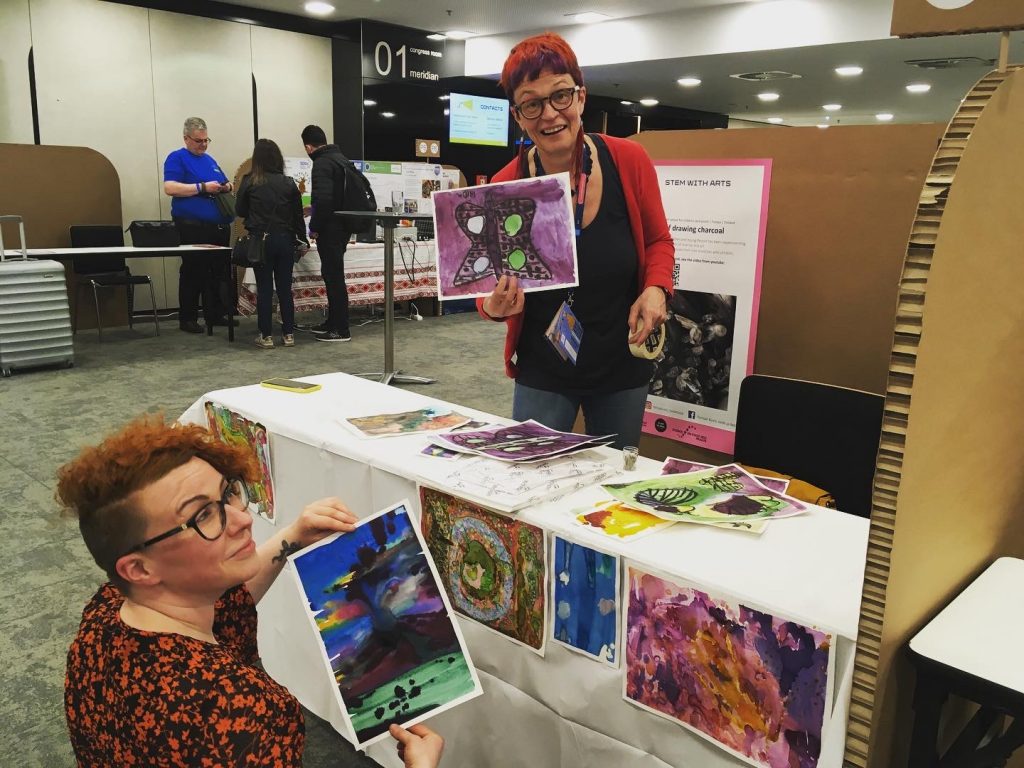
The project “Manufacture of drawing charcoal” by Forssan kuvataidekoulu was awarded with an honorary notion in the category STEM with Arts.The teacher Teija Lauronen and Maikku Aho from Forssan kuvataidekoulu enjoyed the Festival and obtained new teaching ideas as well as inspiration.

– The Festival was interesting and it gave new ideas for my job. The art teacher’s eyes spotted projects that could be utilized while making art, noted Lauronen.

Maikku Aho and Teija Lauronen at their stand.

The delegates of Finland presented their innovative teaching concepts in a fair and in workshops. You can read more about them from our earlier post.

International Seminar for STEAM Doctoral Students 25.-26.8. – call for short papers

This “Call for proposals” introduces a PhD seminar program, organised in Helsinki 25th-26th August, and activities for students before the seminar. As a joint activity, there will be two workshops August 24th. The seminar and workshops are free and open for doctoral students in Finland, Estonia and Israel and are part of the Horizon 2020 SciCar project.

Where: Helsinki, Faculty of Educational Sciences, Siltavuorenpenger 10
When: August 25th – 26th 2022, + workshops and personal consulting August 24th

The seminar is appropriate also for students, participating in Maker@STEAM Creative collective seminar in Helsinki.

The credit points earned at the seminar should be agreed with the main supervisor. The seminar and the work beforehand correspond about 2 – 3 credit points.

To apply and register for the seminar, there are three possibilities for PhD students:

  1. Oral presentation: A student is required to write a short paper in English, about 1500 words or 3–4 pages (cf. guidelines for short papers attached). The paper could introduce a “draft”, which is aimed to be published later in a journal. The draft could be a description of the analysis of one data set together with an introduction and discussion. The draft could also be a modified or elaborated previous proposal to a conference. It is not necessary to organize proofreading to the paper because it is a draft by its nature.

  2. Poster presentation: In the case, the PhD studies are in the beginning and only preliminary data has been collected or no data has not yet been collected, a student can present a poster in the seminar. The student is required to write a short paper in English, about 500 words or 1.5 pages.

    Following topics could be introduced in the paper: research plan; objectives of the research; research methods and data collection; data or research material to be used or preliminary data; expected results or preliminary results; references It is not necessary to organize proofreading to the paper because it is a draft by its nature.

  3. Join without a presentation. It is also possible to attend without a presentation as an audience. In this situation, the lunch will be at your own cost.

Register here by filling out the form.

The short papers should be sent before May, 15th.  The paper will be reviewed by one doctoral student from the respective other groups (cf. guideline for review below). Reviews are due four weeks later, on June 15th. The reviews will be sent to the author of a short paper for helping him/her prepare the final presentation. The abstracts and reviews
should be sent to Jari Lavonen (jari.lavonen@helsinki.fi).

Presentations are grouped into sessions. There are two presentations per session, which leaves ample opportunities for discussion. It is these discussions that are supposed to make the meetings an interesting and informative happening for the presenters as well as their audience. In the case we got more presentations than there are places in the preliminary program, we will organize parallel sessions. There will be one poster session in the seminar.

There will be 45 minutes for each presentation, which are roughly divided into a 20-minute talk (the talk will be stopped if 25 minutes are exceeded) and a 10-minute evaluation/discussion led by the opponent or the person who made the review. The rest of the 45 min time will be allocated for open discussion and feedback. The session chair will organize a discussion based on the presentations and comments after the session in a common lunch or coffee table. The details of this session will be introduced at the beginning of the session by the session chair.

The workshop day on August 24th consists of two workshops. The first workshop focuses to a design of a
cognitive test, such as validity and reliability issues related to the test. The second workshop focuses to collecting and analysing situational data, such as ESM data.

Welcome to Helsinki!
Jari Lavonen & Miia Rannikmäe

More information about the seminar, its programme and the format of the papers (.pdf)

The best Finnish ideas for STEM education are present at the Science on Stage 2022

At the Science on Stage festival in 24-27 March 2022, 450 European science teachers will work together to shape science education of the future. Finland will be represented by the best teachers who have been selected through the StarT-program. Follow the festival on social media #sons2024.

The three-day educational festival Science on Stage will take place from 24 to 27 March in Prague. 450 teachers from over 30 countries will come together to present and exchange their innovative teaching concepts in a fair, in workshops and in short lectures. From a symphony of atoms to the production of foils from starch and the usage of microcontroller in physics lessons, there will once again be a variety of practical teaching ideas from teachers for teachers. 

The delegates of Finland at the Science on Stage Festival 2022 are teachers and educators from Forssan kuvataidekoulu, Länsiharjun koulu and Taipalsaaren kirkonkylän koulun esiopetus. The delegates have been chosen as a part of the Finnish StarT program: the teachers convinced the jury with teaching practices that emphasize for example sustainable development, co-operation and multidisciplinary. Now they head for the international Science on Stage festival to inspire and enthuse colleagues from across Europe with their teaching ideas.

Teachers matter! They are the ones who can enthuse students for STEM (science, technology, engineering and mathematics) and thereby prepare them for the future! At the 12th European Science on Stage festival 2022, hosted by Science on Stage Czechia in cooperation with Science on Stage Europe, the participating teachers will be given the right tools to do so.  

Particularly outstanding projects will receive the festival’s European STEM Teacher Award and will later be disseminated internationally as training courses or teaching materials. In this way, teachers reach thousands of students throughout Europe with their ideas encouraging them to consider a career in science, IT or engineering.

This year’s festival is under the patronage of Mariya Gabriel, Member of the European Commission, and is endorsed by the Czech Ministry of Education.

About Science on Stage 2022

Venue: Clarion Congress Hotel Prague, Freyova 33, 190 00 Prague 9 ⁠⁠-⁠⁠ Vysočany, Czechia 

Open Day for the public: Saturday, 26 March, 10:00 – 17:00 

For media representatives: Please register at press@science-on-stage.eu 

More Information

Winners of Nord StarT competition announced – diverse solutions presented for climate change

The Finnish Ministry of Education and Culture organised the Nordic Nord StarT Climate Change Competition in autumn 2021. The competition was part of the programme of Finland’s Presidency of the Nordic Council of Ministers in 2021. Organised in cooperation with the LUMA Centre Finland’s StarT programme, the competition aimed to engage children, young people and adults, all the way from early childhood education and care to higher education, to come up with concrete ways to tackle climate change. Minister of Education Li Andersson congratulated the winners on Wednesday 9 February 2022 at an open online event.

It was possible to enter the Nord StarT competition with projects or practices where different age groups at different educational levels work together. Schools, groups, clubs or any other set of children, young people or adults could enter a good project in the competition showing how to tackle climate change. Teachers were able to participate in the competition by entering a good teaching practice. The competition was designed for all educational levels from early childhood education and care to higher education. 

The works of the winners covered a broad range of topics on climate issues from the Bokashi method to sustainable poetry. In her award speech, Minister of Education Li Andersson emphasized the importance of schools offering knowledge and skills to combat climate change.

– Environmental issues and climate change are our main societal challenges. Climate change mitigation affects every aspect of society. It is important that schools and educational institutions are able to provide good knowledge and skills to deal with the climate crisis. Effective and research-based sustainability education helps to focus young people’s concerns towards action to tackle the crisis, said Minister Andersson.

The Nordic jury felt that the winning projects harness scientific practices by means of investigation and lab collaboration, empower students and give a voice to children too. According to the jury, the projects also empower young people to take action by themselves and together with others, and use culture and poetry to showcase children’s and young people’s own thoughts about climate change.

The main prizes amounted to EUR 500. The winners of the competition are:

  • 0 to 5-year-olds Piilometsä early education centre – Bokashi and biocarbon in horticultural cultivation
  • 13 to 15-year-olds Vuoksenniska school centre – Young children and climate change
  • 16 to 18-year-olds
    • Chemistry students at the Rajamäki unit of Nurmijärvi General Upper Secondary School – Toxins in nature
    • FIN-CHI Innovation and Education Association – Youth Race-to-Zero Climate Action
  • Best teaching practice: Sustainable Poetry. Swedish collaboration between teachers and educators.

The purpose of the Nord StarT competition was to showcase what kinds of visions Nordic children, young people and young adults have about climate change mitigation and to present examples of how to curb climate change.  It also aimed to strengthen cooperation and the sense of community among the Nordic countries, develop sustainable development pedagogics and promote curriculum-based activities.

Further information and material:

Evästeasetukset
LUMA-kukka ilman tekstiä

This website uses cookies so that we can provide you with the best user experience possible. Cookie information is stored in your browser and performs functions such as recognizing you when you return to our website and helping our team to understand which sections of the website you find most interesting and useful.

You can adjust all of your cookie settings in this view.

Strictly Necessary Cookies

Strictly Necessary Cookie should be enabled at all times so that we can save your preferences for cookie settings.

Analytics

This website uses Google Analytics to collect anonymous information such as the number of visitors to the site, and the most popular pages.

Keeping this cookie enabled helps us to improve our website.